


 With Jakub Józef Orliński and Sabine Devieilhe heading a first-rate cast, Francesco Corti and Il Pomo d’Oro deliver a “Giulio Cesare in Egitto” of remarkable sonic refinement, shaped by finely drawn orchestral colours and exceptional attention to the singers.
 By
 3 minutes


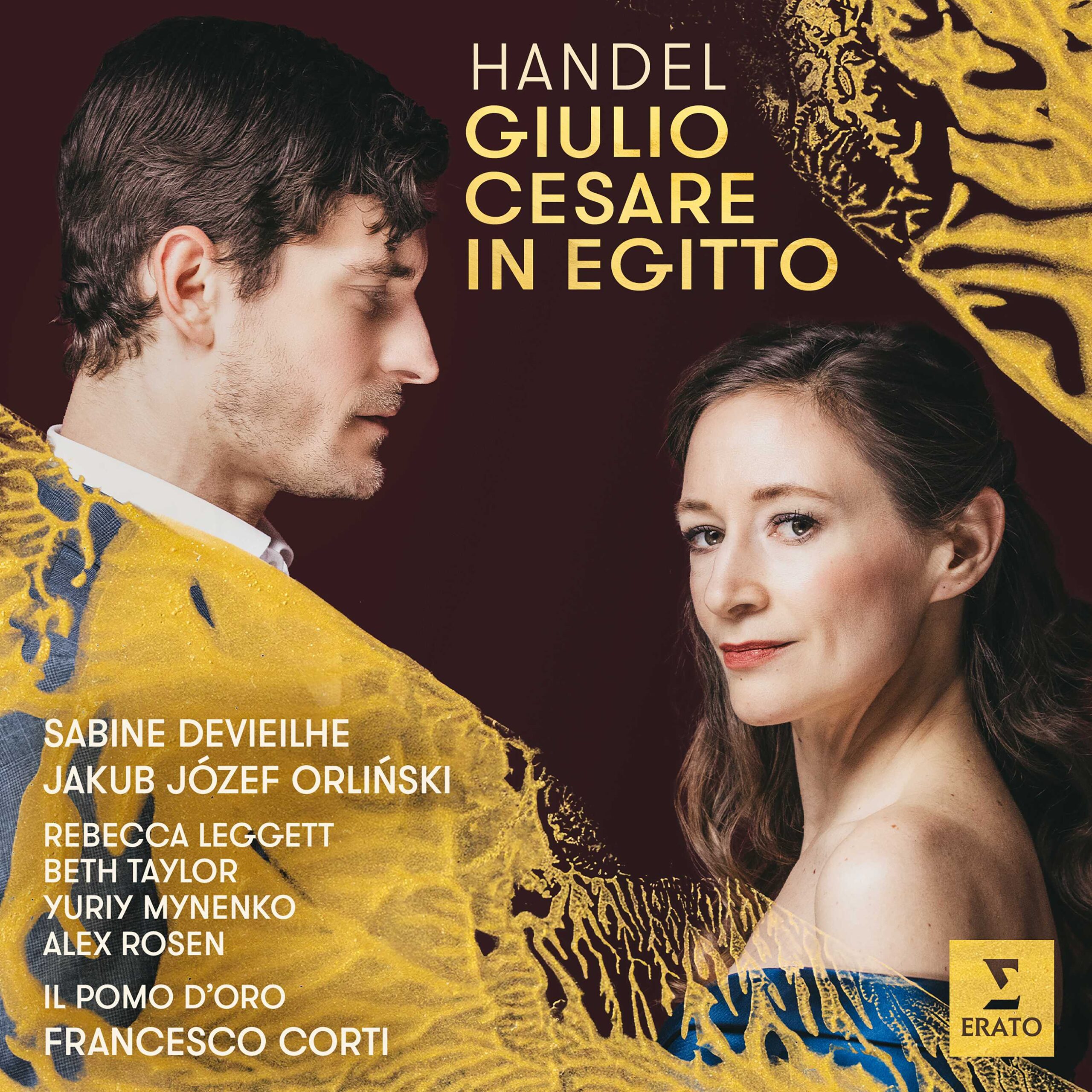
Recorded in Warsaw in February 2026 at the end of an extensive European tour, this new complete recording of Giulio Cesare in Egitto brings together Il Pomo d’Oro and Francesco Corti, conducting from the harpsichord, with Jakub Józef Orliński and Sabine Devieilhe. From Vienna to Madrid via Paris, Amsterdam and Hamburg, the team had time to test the score on stage before committing it to disc. An experience that feeds into a reading particularly attentive to orchestral colour and supported by a first-rate vocal cast.
Among Handel’s most frequently recorded operas, Giulio Cesare in Egitto nevertheless remains a work open to a wide range of interpretations. Its title character provides the clearest example. Written for the celebrated castrato Senesino, Caesar has changed vocal identity repeatedly over the centuries: a heroic baritone in older adaptations, a mezzo-soprano or contralto in travesti in many modern productions, and more rarely a countertenor in complete recordings. This new recording, made in early 2026 at the Warsaw National Philharmonic, belongs to the latter tradition.
Francesco Corti and Il Pomo d’Oro approach the score with constant attention to instrumental detail. The exceptionally clear recording brings out the individual timbres without ever disturbing the balance. Corti favours textures, colours and close interaction with the singers. The recitatives therefore benefit from lively, richly characterised accompaniment, while some arias reveal an almost chamber-like attention to the instrumental lines. In “Se in fiorito ameno prato”, the solo violin seems to extend the inflections of the voice; elsewhere, the continuo contributes subtly to the psychological portrayal of the characters.
This search for refinement is both the strength and the limitation of the approach. The wealth of detail often captivates the ear, but the broader dramatic arc can sometimes feel less firmly defined. The overture lacks a little structural momentum, and some numbers would benefit from more decisively established tempi. A few abrupt transitions also weaken the continuity of the discourse. The choral passages, by contrast, display fine cohesion and careful characterisation.
The principal strength of the set remains its cast. As Cleopatra, Sabine Devieilhe impresses as much through her virtuosity as through the intelligibility of the text. The brilliance of her coloratura never comes at the expense of line or expression. Her interpretation combines technical brilliance and dramatic instinct with remarkable ease. In “Piangerò la sorte mia”, her attention to nuance sustains a consistently controlled emotion, while the more vehement passages retain all their precision.
Opposite her, Jakub Józef Orliński makes a convincing case for casting a countertenor in the title role. His luminous timbre, flexible coloratura and breath control shape a Caesar who is at once conquering, noble and elegant. The contrasts between registers add depth to the characterisation, while the particularly crisp recitatives help maintain the flow of the drama. The final duet with Devieilhe ideally illustrates the complementarity of the two artists.
Around them, the cast is remarkably consistent. Beth Taylor lends Cornelia a painfully dignified presence that remains deeply moving, while Rebecca Leggett creates a lively and determined Sesto, displaying the breadth of her vocal resources in both virtuosic high notes and more assertive lower registers. Yuriy Mynenko portrays a subtly unsettling Tolomeo, skilfully using contrasts of register to underline the character’s ambiguity. Rémy Brès-Feuillet establishes a clear rapport with Cleopatra in their recitatives, Marco Saccardin gives Curio a solid moral authority, while Alex Rosen brings Achilla the necessary energy and roughness.
Without fundamentally redefining current approaches to Handel’s most famous opera, this new recording finds its individuality in the combination of transparent conducting and an accomplished vocal cast. Driven by the Orliński–Devieilhe partnership, it stands as a major contribution to the work’s discography and may even be, to date, the reference among complete recordings featuring a countertenor as Caesar.
Technical details
Title: Giulio Cesare in Egitto, HWV 17
Composer: George Frideric Handel (1685–1759)
Libretto: Nicola Francesco Haym (1678–1729), after the libretto by Giacomo Francesco Bussani
Performers: Jakub Józef Orliński (Giulio Cesare), Sabine Devieilhe (Cleopatra), Beth Taylor (Cornelia), Rebecca Leggett (Sesto), Yuriy Mynenko (Tolomeo), Alex Rosen (Achilla), Rémy Brès-Feuillet (Nireno), Marco Saccardin (Curio); Il Pomo d’Oro, Francesco Corti (harpsichord and conductor)
Label: Erato
Format: digital, 3 CDs
Duration: 3 hrs 48 mins
Release date: November 13, 2026




You must be logged in to be able to post comments.
Sign in