


 In the seventeenth century, the violin became one of the principal fields of instrumental invention. With Phantastico, Stéphanie Pfister traces this growing autonomy through a repertoire in which forms become more flexible and performers gain new freedom.
 By
 2 minutes


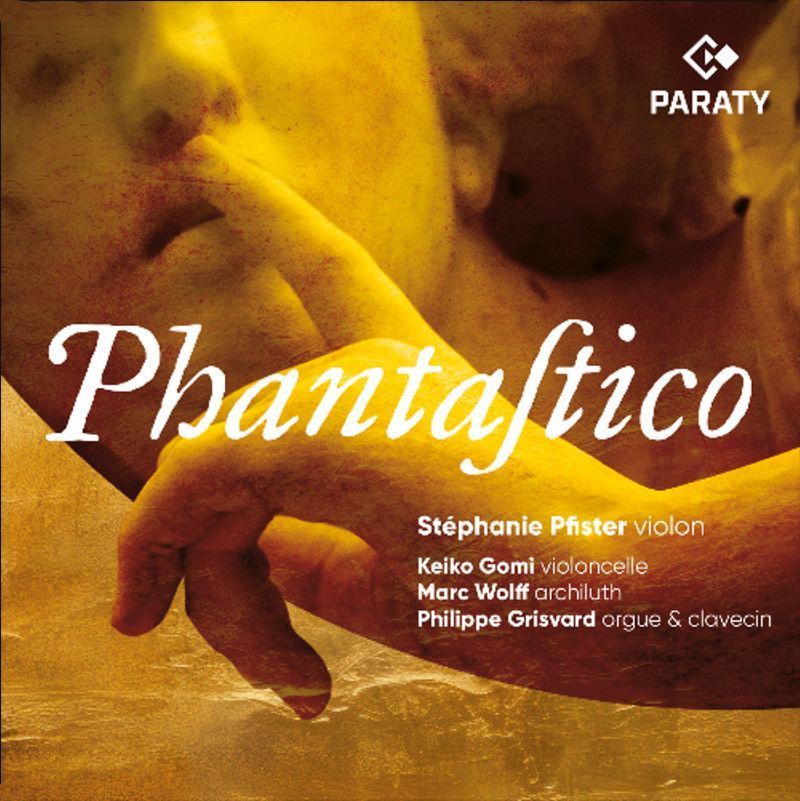
Released by Paraty on October 23, Phantastico brings together violinist Stéphanie Pfister, cellist Keiko Gomi, Marc Wolff on archlute, and Philippe Grisvard on organ and harpsichord. From Bertali to Stradella, the programme gathers seventeenth-century Italian and German works chosen for the variety of their forms and the possibilities they offer both violin and continuo.
As the violin breaks free
The album’s title refers to the stylus phantasticus, a term used by Athanasius Kircher in the mid-seventeenth century and later taken up by Sébastien de Brossard. It does not denote a specific form, but rather a freer way of composing, less bound by fixed models. Preludes, fantasias, capriccios, toccatas and sonatas can therefore multiply contrasts, changes of pace and virtuosic passages, while leaving considerable room for the performer’s own invention.
This freedom accompanies the spectacular rise of the violin. Still closely associated with singing and dancing in the previous century, the instrument gradually asserts its own resources, often through composers who were themselves virtuoso players. Phantastico offers a particularly varied picture of this development: Bertali’s Ciaccona explores variation, Viviani’s Toccata constantly shifts pace, while Böddecker’s Sonata, published in Strasbourg in 1651, is the earliest known printed work for solo violin in the German-speaking world.
A repertoire still inventing itself
Above all, the album reveals instrumental music still searching for its own forms. The sonata has not yet acquired the structure it would take on in the following century, and no two works in the programme are organised in quite the same way. This instability is central to the project: it captures a moment when the violin becomes a genuine laboratory for musical writing.
This evolution also goes hand in hand with the movement of musicians between Italy and the German-speaking world. Several composers represented on the album worked at the courts of Vienna or Innsbruck, while others trained or spent time in Italy. These journeys helped spread new instrumental practices rapidly across Europe and partly account for the diversity of musical languages heard on the recording.
Freedom as a guiding principle
Stéphanie Pfister herself emphasises what attracts her to this repertoire: the interpretative freedom it still leaves today. Despite the abundance of treatises, not everything is fixed; affects, diminutions, colours and phrasing remain largely in the hands of the performers. Pfister describes a music capable of moving from the joy of chaconnes to the darkness of preludes, from the simplicity of an aria to much more tormented harmonies.
The choice of ensemble follows the same logic. Around Pfister’s violin, Keiko Gomi’s cello, Marc Wolff’s archlute and Philippe Grisvard’s keyboards constantly reshape the density and colour of the continuo. Each piece therefore finds its own balance, sometimes centred on the violin, sometimes opening out towards dialogue between the instruments and the play of timbres. Phantastico ultimately sums up this capacity for forms, colours and balances to reinvent themselves from one work to the next.

You must be logged in to be able to post comments.
Sign in