


 At 85, Jordi Savall shows little inclination to slow down. After transforming the way we listen to early music, creating his own ensembles and his own label, the Catalan viol player and conductor is now embarking on a new adventure: the creation of AEVUM, a digital platform designed to return to musicians some of the value that streaming has taken away from them. A new fight for independence—and an opportunity to look back with him on sixty years of music.
  By
By 


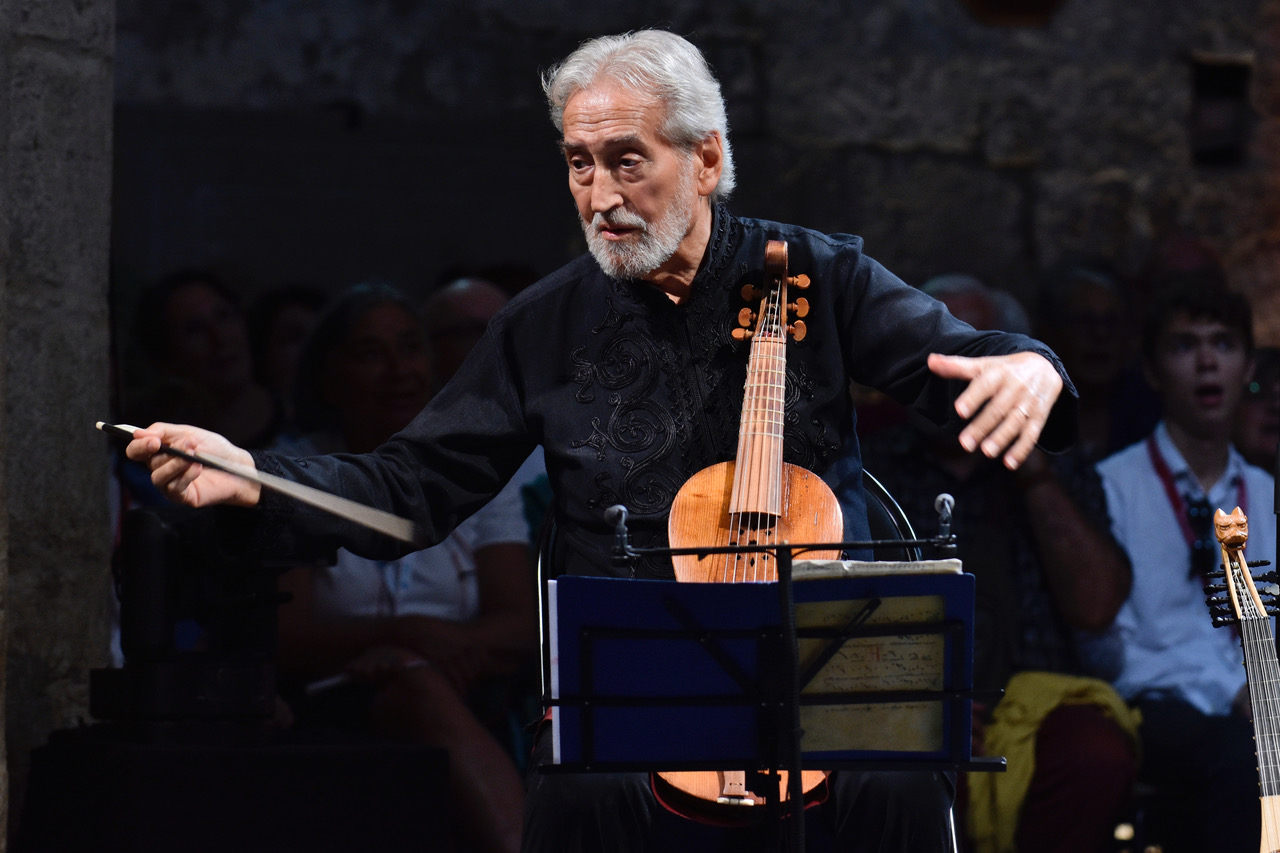
He speaks about Marin Marais and Beethoven, the Schola Cantorum in Basel, Spotify’s algorithms, and the Symphonie fantastique with the same curiosity. On the occasion of the presentation of AEVUM (Latin for “time that has a beginning but no end”), Jordi Savall sat down at length with Total Baroque Magazine before his concert at the Ambronay Festival. Behind this new streaming-platform project lies a conviction that has run through his entire career: to create, an artist must remain free. A freedom he has pursued by founding the ensembles Hespèrion XXI, La Capella Reial de Catalunya, Le Concert des Nations, and his label Alia Vox, and which he now wants to defend in the world of streaming. But Savall also looks back on his formative years, his encounter with the viola da gamba, the adventure of the French film Tous les matins du monde (All The Mornings of The World), passing knowledge on to young musicians, and his ever-deeper exploration of the nineteenth century. With Schumann, Smetana, and Berlioz on the horizon. And this certainty: “Music is what keeps me alive.”
Let’s begin with AEVUM. How did the idea for this new streaming platform come about?
Jordi Savall: I have been producing my own recordings for thirty years, so I deal every day with funding issues and all the difficulties they entail. Over the past few years, I have seen the situation become impossible: what we receive from the platforms is practically zero. I have thought a great deal about this. If we continue this way, classical music risks disappearing in this digital universe, and with it an entire part of Europe’s cultural heritage, swallowed up by popular music, by the general music market, and above all by algorithms. So I began reading a great many articles and books on these issues. I have now been managing my own projects for thirty years and observing what is happening in the recording world. So I analysed this new situation at great length, then I called Yves Riesel, whom I know well. He was there when Alia Vox was founded and became its distributor. We came to the same conclusion: we cannot continue like this. We began thinking about how we could offer something different. That is how AEVUM was born. I am the initiator and one of the founders of the project, together with Yves, my wife Maria Bartels, Éric Guillemaud, who is responsible for Alia Vox’s international distribution, and others. We organised meetings and commissioned studies. And all of this coincided with the Siemens Prize that I received.
With €250,000 in prize money, it is financially significant…
J. S.: Yes. And I decided to use part of what would remain after taxes to launch the project.
So you are personally reinvesting part of this prize money in AEVUM?
J. S.: Yes. First, we needed resources to pay four or five people to study everything we need in order to get the project off the ground. We have worked a great deal and had many discussions. And the conclusion is simple: if we do nothing, the situation of classical music will continue to deteriorate. A large part of the sector already belongs to the majors, which naturally do as they please. Our intention is not to fight against the majors or the existing platforms. We simply want to offer something different.
With AEVUM, what you ultimately want to do is bring together several musical niches: classical music, jazz, world music…
J. S.: And early music, of course! Look at one of the major problems with the way platforms operate: remuneration is calculated according to systems that favour very short listening periods, of around two minutes. Yet most symphonic movements last much longer than two or three minutes. The system is obviously much better suited to pop, where songs last two or three minutes and allow listeners to move quickly from one track to the next. So we want to introduce remuneration based on actual listening time, calculated by the second. Ultimately, that is quite logical: when we sold a record, it represented a complete object; in the digital world, we need to be able to take into account the actual duration of what is listened to. There is a second problem: on generalist platforms, classical and early music are submerged in an enormous market.
Passionate about early music and want to read this subscriber-only article?
If you are not a subscriber, join the international Total Baroque community. Subscribe here from 5.00€.
I subscribe
If you are already a subscriber, sign in.
I sign in 

You must be logged in to be able to post comments.
Sign in