


 As Handel shaped the English oratorio in London, he did not turn his back on the great Italian opera stars, even adapting his scores to suit their voices. With “Handel’s Italians”, Carlo Vistoli, Emmanuelle Haïm and Le Concert d’Astrée bring these tailor-made versions back to life.
  By
By 


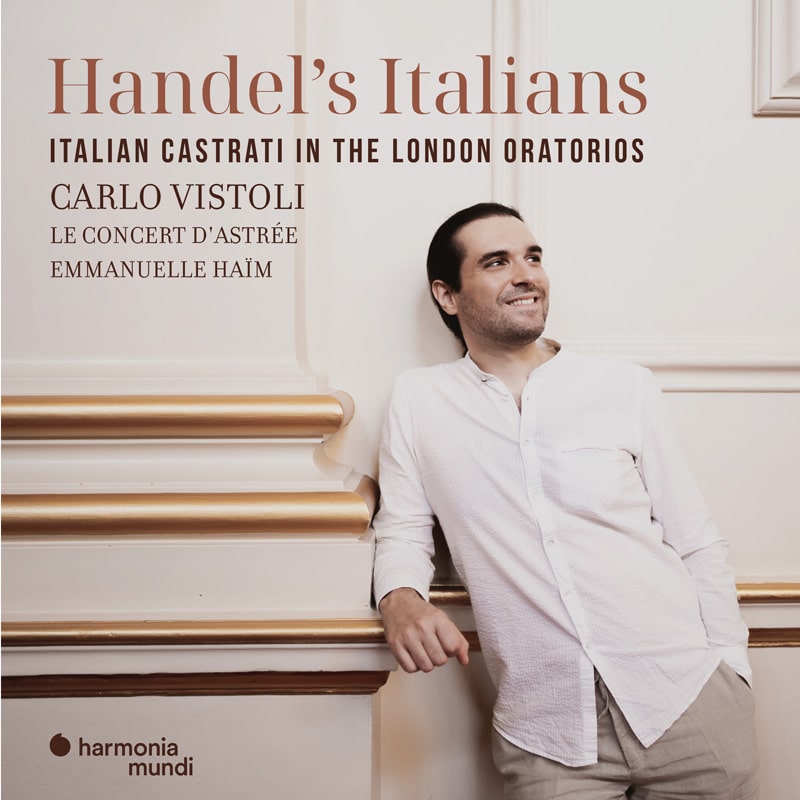
With Handel’s Italians – Italian Castrati in the London Oratorios, released by Harmonia mundi on 4 September 2026, Italian countertenor Carlo Vistoli, French conductor Emmanuelle Haïm and Le Concert d’Astrée explore a distinctive aspect of Handel’s output: the place of Italian castrati in his London oratorios. From Senesino to Guadagni, via Carestini and Andreoni, the album follows four singers who prompted the composer to reshape his music according to their voices, individual qualities and, at times, their more or less secure command of English1. From Esther to Theodora, the journey reveals, behind the apparent fixity of the scores, a far more fluid musical and performing history.
This is what sets the project apart from a straightforward Handel recital. Carlo Vistoli follows in the footsteps of four very different castrati without attempting the impossible task of reconstructing their voices; instead, he brings out the variety of writing they inspired. His rounded, supple tone, clarity of diction and, above all, his ability to make ornamentation an extension of the text allow him to move naturally from virtuoso brilliance to far more introspective lines. The challenge is all the more compelling because these pieces were not all written for the same kind of voice: brought together around a single performer, they offer less a portrait of some ideal castrato than of a Handel constantly attentive to the resources and personality of each of his singers.
Around Vistoli, Emmanuelle Haïm and Le Concert d’Astrée likewise avoid turning the programme into a gallery of showpieces. The orchestra preserves the music’s dramatic urgency while knowing how to lighten its touch when the writing becomes more contemplative. Alongside the Italian countertenor, soprano Giulia Semenzato is a welcome presence: her appearances periodically restore a sense of dialogue and remind us that these arias belong first and foremost to characters and dramatic situations. Much of the album’s appeal lies in this balance between virtuosity and expression, scholarly programming and the immediacy of the singing and drama.
Handel’s Italians thus offers a fresh way of hearing repertoire we may think we know well. The rarities are not revived merely for curiosity’s sake: they reveal how Handel worked, revisiting his compositions as new singers came into his orbit and allowing the colours of Italian opera to circulate within the English oratorio. That may be the album’s most enticing achievement: behind the learned historical investigation, what we hear above all is remarkably fluid, theatrical and human music, which Vistoli, Haïm and Le Concert d’Astrée seem to set in motion once again before our ears.
- During Esther in 1732, a pamphleteer mocked the Italian countertenor Senesino’s pronunciation, claiming that it sounded almost “Welsh” — in other words, notoriously difficult to understand. An anecdote even has it that, in the same work, “I come, my Queen, to chaste delights” was heard as “I comb my Queen to chase the lice” — a rather more entertaining story, though its attribution is now disputed… ↩︎


You must be logged in to be able to post comments.
Sign in