


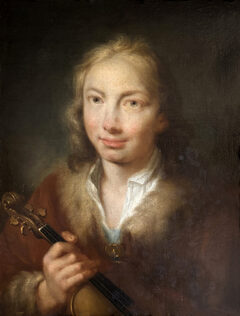
 Why is Rameau holding a violin in one of his rare portraits? Taking this mystery as their starting point, Théotime Langlois de Swarte and William Christie explore the instrument’s little-known place in the composer’s world. From operatic transcriptions and dances to sonatas by his contemporaries, an intimate portrait of Rameau in which the violin becomes by turns singer, dancer and actor.
  By
By 


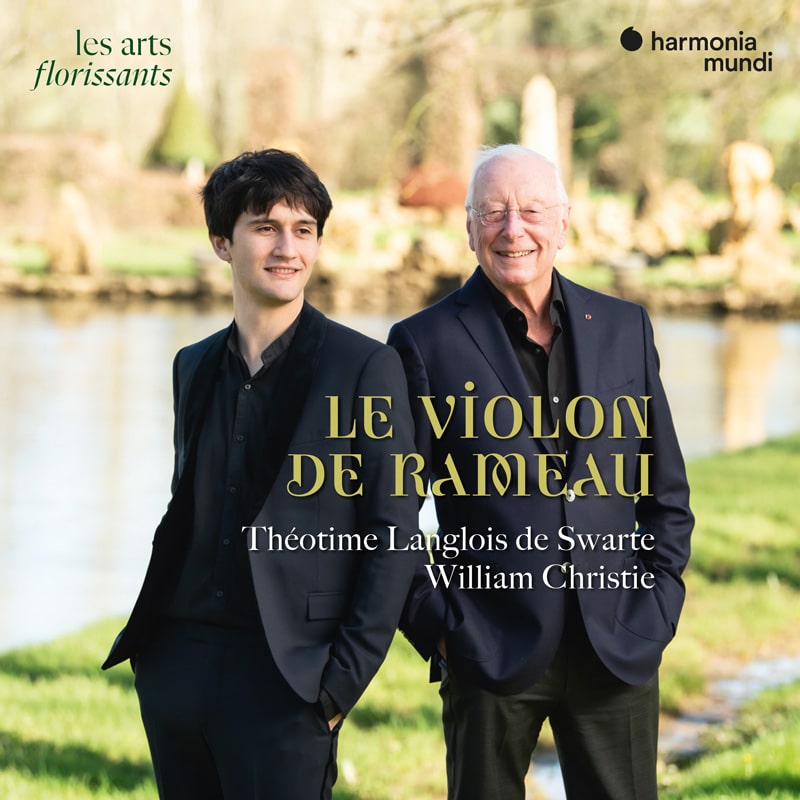
We know Rameau as a theorist, harpsichordist and opera composer. But Rameau the violinist? It was while looking at a portrait attributed to Joseph Aved, in which the composer is shown holding a violin, that Théotime Langlois de Swarte conceived this programme with the American conductor William Christie. Released by Harmonia mundi, Le Violon de Rameau (Rameau’s violin) starts from a fruitful paradox: Rameau left neither a violin sonata nor a concerto, yet the instrument accompanied him throughout his career and occupies an essential place in the orchestra of his operas.
Contemporary accounts lend weight to this idea: the Dijon physician and scholar Hugues Maret reported that Rameau composed his operas ‘with a violin in his hand’, trying out on the instrument the effect of the airs he imagined. The album therefore sets out in search of this ‘Rameau violin’ in Hippolyte et Aricie, Castor et Pollux, Dardanus, Les Fêtes d’Hébé and, above all, Les Indes galantes. Many of these pieces come from a manuscript copied after 1771 by the lawyer and man of letters Jacques-Joseph-Marie Decroix, a major collector of Rameau’s works, entitled Airs de violon tirés des opéras de Rameau.
Rameau is also surrounded by several violinists of his time: Jean-Baptiste Cupis, Jacques and Louis Aubert, Charles-Antoine Branche, André-Joseph Exaudet, Toussaint Bordet and Théodore-Jean Tarade. Sonatas, airs and variations thus place his music within the landscape of eighteenth-century French violin playing. The programme also continues a well-established practice of the period – transcribing operatic airs for violin – which Rameau himself encouraged, notably by producing a reduced version of Les Indes galantes.
With just two performers, Théotime Langlois de Swarte and William Christie bring this theatrical world into the intimacy of chamber music. Dispensing with cello and viola da gamba, they redistribute orchestral and vocal lines between violin, harpsichord and organ, while also making room for improvisation. Langlois de Swarte plays a 1733 Carlo Bergonzi violin1, while Christie alternates between the harpsichord and the 1714 Boizard organ at the Abbey of Saint-Michel-en-Thiérache. The journey ends, like a curtain falling, with the great Chaconne from Les Indes galantes. All that remains is to listen: with just two instruments, the entire theatre of Rameau springs back to life.
- An amusing coincidence for music lovers: this Carlo Bergonzi (1683–1747), the great Cremonese violin maker and contemporary of Stradivari, has of course nothing to do with his famous namesake, the Italian tenor (1924–2014). ↩︎

You must be logged in to be able to post comments.
Sign in