


 From the very first bars, the “St John Passion” reveals itself like an old master painting freshly revarnished under the brush of Raphaël Pichon and his ensemble Pygmalion: the lines become firmer, the contrasts sharper, the light begins to circulate, revealing unexpected gleams and rough edges.
  By
By 


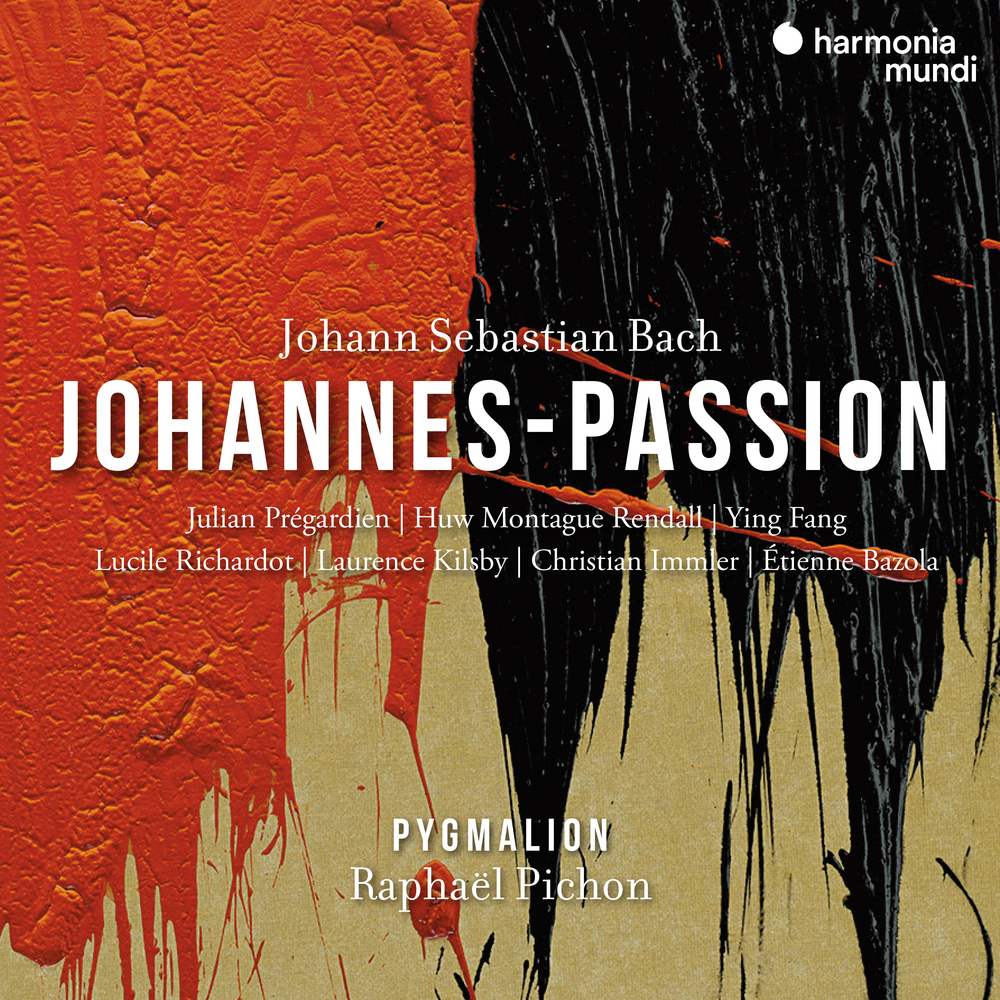
For this new recording on Harmonia Mundi, Raphaël Pichon and Pygmalion, who will soon be following the composer’s footsteps with Les Chemins de Bach 2026, return to the Cantor of Leipzig with a St John Passion that favours narrative clarity and finely drawn lines. Four years after an acclaimed St Matthew Passion, the ensemble continues its exploration of the sacred repertoire with a taut, restrained, and historically informed reading of the Johannine work. This approach brings out the narrative richness of the text through the expressive delicacy of the score.
From the opening chorus, Raphaël Pichon’s direction asserts a clarity that immediately establishes the dramatic tension. The rhythmic underpinning, incisive without harshness, creates a momentum that never departs from the work’s religious sobriety. The strings draw taut, nervous lines, while the luminous woodwind pierce the darkness of the narrative, already sketching the contrast between divine elevation and human abasement. The continuo, always attentive and never intrusive, supports the voices with a delicacy that preserves the clarity of the text. The organ’s interventions, solemn and slightly bitter, heighten the gravity of the crowd’s choice of Barabbas over Jesus. The recording, remarkably transparent, brings out the period timbres and the balance between the choral and orchestral sections.
The Pygmalion choir stands out for a precision that never comes at the expense of expression. The vocal textures are handled with restraint, and the vocal parts are articulated with remarkable clarity, giving the narrative a smooth flow. In the chorus following Peter’s denial, the piano nuances convey a restrained empathy. Later, the ‘Kreuzige!’ (‘Crucify him!’) rise up with a lighthearted, carefree cheerfulness, reflecting the grim inconsistency of the Jewish people. This ability to move from one affect to another without breaking the narrative line is one of the strengths of the recording.
Among the soloists, Julian Prégardien, in the role of the Evangelist, delivers a narration of great lucidity. His light, precise voice structures the dramatic progression naturally, and his upper notes, sometimes in head voice, bring an elevation that serves the spiritual dimension of the narrative. Huw Montague Rendall portrays Jesus as a young man whose words are often spoken with a solemn gravity, immediately establishing the character’s almost transcendent authority. The consistency of the timbre reinforces this dimension, though more supple passages allow a more immediate, almost fragile humanity to come through. The more extended arias give this duality its full breadth, particularly in the arioso, where the voice opens out into a tenderness tinged with bitterness.
As Pilate, Christian Immler
Christian Immler, as Pilate, brings a powerful, sometimes almost harsh vocal presence that underscores the character’s sternness. His clear diction and precise phrasing effectively shape the bass aria entrusted to him. Tenor Laurence Kilsby impresses with the mastery of his line and the purity of his head voice. His long, perfectly controlled breath gives the phrases a striking expressive continuity. Lucile Richardot brings a serene gravity to the alto arias. Her breathing and timbre find a balance between calm and solemnity, especially in the scene leading to Christ’s final words. Ying Fang offers an airy soprano, finely ornamented. In the final aria, every nuance seems to resonate with the text, as if the voice were carrying the tears mentioned in the lyrics. Étienne Bazola’s brief interventions as Peter, meanwhile, stand out for a sharpness that underlines the brutality of the denial.
In this St John Passion, clarity becomes a principle of organisation as much as an aesthetic choice. It reveals the structural forces of the drama, the contrasts of the Johannine text and the fragility of the human voices that pass through it. Pygmalion’s approach, founded on precision and mutual listening, offers a reading that does not seek to magnify the work, but to reveal its essential contours. An approach to Bach that, far from freezing the score in place, breathes new life into it.
Technical details
Work: Johannes-Passion BWV 245 (1749 version)
Composer: Johann Sebastian Bach (1685-1750)
Version: recording, Grand Manège, Namur (Belgium), April 2025
Ensemble (choir and orchestra): Pygmalion
Conductor: Raphaël Pichon
Cast:
- Julian Prégardien, tenor – the Evangelist
- Huw Montague Rendall, baryton – Jesus
- Ying Fang, soprano – Ancilla
- Lucile Richardot, alto
- Laurence Kilsby, tenor – Servus
- Christian Immler, bass – Pilate
- Étienne Bazola, bass – Peter
Label: Harmonia Mundi / 2 CD
Total duration: 1h55


You must be logged in to be able to post comments.
Sign in