


 From silence as a prerequisite for music to a questioning of authenticity, Paul Van Nevel, at the age of 80, continues his rigorous exploration of early music, while his leading tenor, Achim Schulz, is gradually taking the helm of the Huelgas Ensemble, in a process of succession that is still unfolding.
  By
By 


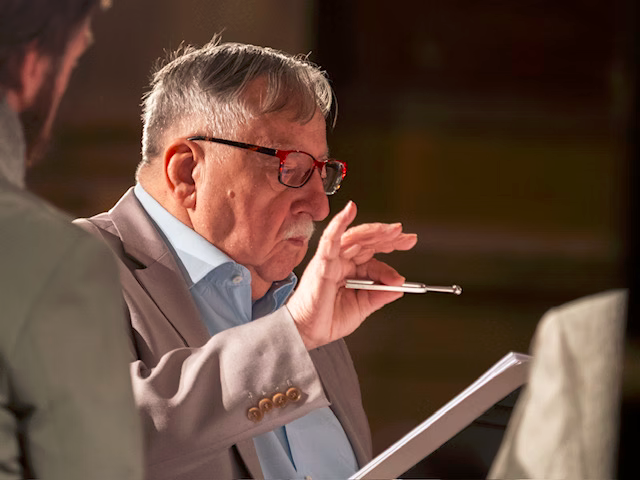
Based in Leuven, the Huelgas Ensemble has established itself over the past fifty years as one of the leading performers of the polyphonic repertoire from the 14th to the 16th centuries. At 80, its founder Paul Van Nevel continues his exploration by questioning its very foundations: silence, the perception of sound, the illusion of authenticity, the transfer of power. As he gradually prepares his succession with the tenor Achim Schulz, the ensemble is at a turning point, caught between staying true to a certain aesthetic and embracing a new balance. This is the final part of the interview, with both men present.
In the first part of this interview, you mentioned several important stages in the history of your ensemble, as well as the main realization arising from your long work on the repertoire of the 14th to the 16th centuries. What other important discoveries could you share with us?
Paul Van Nevel: The importance of silence. The dynamics of a work depend on it. In the past, rehearsal spaces as well as concert venues were largely marked by silence. A child grew up in silence. Of course, there were sounds—a dog barking, bells, a cart rumbling… But the underlying feeling was that of silence. This is a feeling we have lost. Yet music begins with silence. In a concert, the two seconds preceding the beginning are, for me, the most important moment. Total silence. It was from that silence that we sang. Today, we’re already satisfied when the noise level drops just a little. But back then, singing very softly meant being just above the silence. It was almost the norm. Today, the overall dynamic is far too loud. This intensified with the emergence of the orchestra, but even in the purely vocal repertoire, we sing too powerfully. This stems from the loss of the sense of silence. The definition of silence has, moreover, evolved since the 16th century. In the 19th century, one finds definitions describing it as an interruption of noise. It is therefore a complete reversal of the concept.
What have been the most memorable moments of these fifty-five years with Huelgas, if any stand out?
P. V. N.: Yes. And, curiously, one of the most important is the concert we gave a few weeks ago at Notre-Dame de Paris. For us, it was a real milestone.
Why?
P. V. N.: Because we sang music there that was written specifically for that place, that of Pérotin and Léonin. And we know more about performance practices around 1200 than about the entire 15th century; we were even able to position ourselves in the exact place where the singers stood at the time—this location is known. Of course, the cathedral no longer sounds today as it did in 1200 (I will spare you the details), but we need to look at things objectively: authenticity, in the absolute sense, does not exist. Anyone who claims to be authentic is lying. It is impossible. The only thing we can do is to give today’s audience, for whom we sing, an idea of the emotions, the aesthetic demands and the vocal aesthetics that were decisive in the 13th, 14th or 15th centuries. But this can only be an attempt at approximation. To say: “this is how it sounded in the 13th century” would be a lie. Our hearing has changed; around 1200, it was much more sensitive than it is today. Someone who spends every week at nightclubs today will no longer hear the same way by the time they’re thirty. That kind of constant exposure to loud noise didn’t exist in 1200.
Which repertoires have you already explored, and which would you still like to approach?
P. V. N.: What I still wish to do goes beyond what I have already accomplished. But I will obviously not have time to do everything. What I have done so far, you also know: I have approached both the great names such as Lassus or Dufay and lesser-known composers such as Alexander Agricola. And the music of the latter is extremely singular. I have always been drawn to composers who are not afraid to cross boundaries and go beyond what has already been achieved in the history of music, those who seek what can still be interesting, still adventurous. When it comes to the rhythmic complexity of melodic lines, Agricola went very far, even further than Johannes Ockeghem. It is composers of this kind who have always interested me and who continue to interest me. An example of a project I absolutely wish to carry out (this will be in 2027) pertains to the music of Ivo de Vento, born in 1544 in Antwerp. When Orlando di Lasso went to Antwerp to recruit children for the court chapel in Munich, he took de Vento with him. De Vento was then trained at the Munich court, where he later worked as an organist. He was also cantor in the summer residence of the Dukes of Bavaria in the Alps, when he spent holidays there with the court. He composed extensively, in very varied genres: German lieder that sometimes verge on the burlesque, but also motets, masses and many other things. He is an extremely prolific composer and of the very first rank. The fact that his works were included in the Munich choir books already says a great deal about his importance.
Passionate about early music and want to read this subscriber-only article?
If you are not a subscriber, join the international Total Baroque community. Subscribe here from 5.00€.
I subscribe
If you are already a subscriber, sign in.
I sign in 

You must be logged in to be able to post comments.
Sign in