


 At 80, Paul Van Nevel continues to view polyphony as an art of time: balancing rhythmic precision, the legacy of Gregorian chant, and an unwillingness to compromise, he looks back on fifty-five years of exploration with the Huelgas Ensemble, at the heart of a repertoire that is as essential as it is underappreciated.
  By
By 


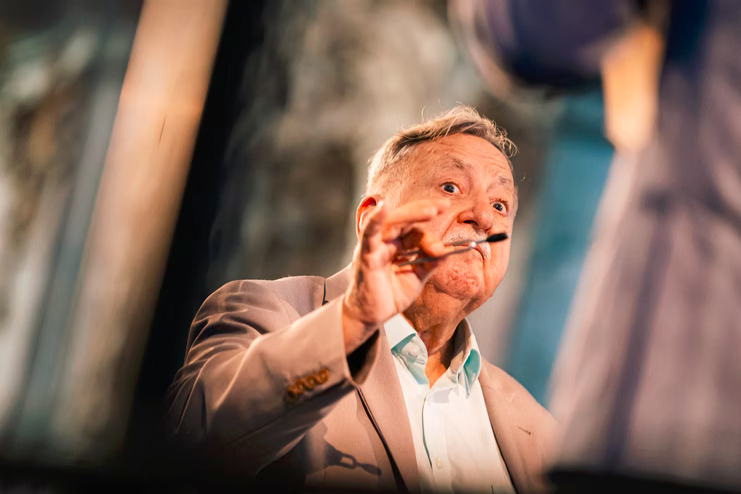
Based in Leuven, the Huelgas Ensemble is among the leading ensembles for the repertoire of the 14th to 16th centuries. This year, the ensemble celebrates its 55th anniversary, while its founder and director, Paul Van Nevel, turns 80. On this occasion, he reflects on his long-term work on early polyphony: the relationship to time and notation, rhythmic rigour, the training of singers, and the concrete conditions for performing a repertoire that is as vast as it is little known. First part of the interview.
You celebrated your 80th birthday on February 4, and you founded the Huelgas Ensemble 55 years ago, in 1971. What seems most important to you to celebrate?
Paul Van Nevel: The anniversary is undoubtedly the most important thing, and the whole project is, in a way, my reason for being. My own life is just taking its course, and we’ll see how it goes… so far, everything has gone very well (laughs). My health is excellent, so we’re just going to keep going. But of course, I do not know what I am going to do with myself; on the other hand, I know very well what I want to do with the ensemble, and that is what matters.
What do you mean when you say you don’t know what you’re going to do with yourself?
P. V. N.: Well, I could drop dead tomorrow. But an ensemble does not simply drop dead; it continues to exist. Or tomorrow, I might no longer feel like working with the ensemble, no longer have the drive; in that case, I would stop. But fortunately, for now, I still feel like it. Then it also depends on how I feel about travelling and life on tour: it is demanding, and if it becomes too much for me, I will stop. But that’s not the case at the moment. Right now, I still have an enormous number of projects prepared that I am absolutely determined to carry out!
Originally, Huelgas was not founded as a vocal ensemble, was it?
P. V. N.: Indeed, we began in 1971 as a quartet. The four of us were students in the class of Johannes Colette [Dutch recorder player and pedagogue (1918–1995), a pioneering figure in the rediscovery of the instrument in the 20th century and a professor at the Maastricht Conservatory], and it was thanks to him that we started Huelgas, at the time mainly with instruments in very varied combinations: all of us played the recorder, two also played the vielle, one also the crumhorn. This gave us many different ensemble options. It was only in the second or third year of our existence that I myself began to sing. I had, of course, sung for six years at the episcopal college and therefore had solid vocal experience. But after a year, I told myself: no, I don’t want to become a professional singer. So we brought in other singers, and it developed from there. In the 1980s, I finally came to understand that our repertoire, polyphony, belongs above all to the vocal domain, and so we gradually offered more and more a cappella programs. Today, we use instruments only when it is truly necessary or corresponds to the original context of the music. I am thinking, for example, of Claude Le Jeune, who set many psalms to music; in that case, instrumental participation is entirely possible. In contrast, in the Vatican repertoire in Rome, not at all: it is naturally a strictly a cappella repertoire. At present, around 80% of our programs are therefore a cappella.
Passionate about early music and want to read this subscriber-only article?
If you are not a subscriber, join the international Total Baroque community. Subscribe here from 5.00€.
I subscribe
If you are already a subscriber, sign in.
I sign in 

You must be logged in to be able to post comments.
Sign in