


 Composed a decade after Handel’s and long forgotten since, Geminiano Giacomelli’s Cesare in Egitto has been brought back to life on disc by Ottavio Dantone and his Accademia Bizantina, who capture all its flavour and originality. A discovery worth hearing!
  By Julien Delhom


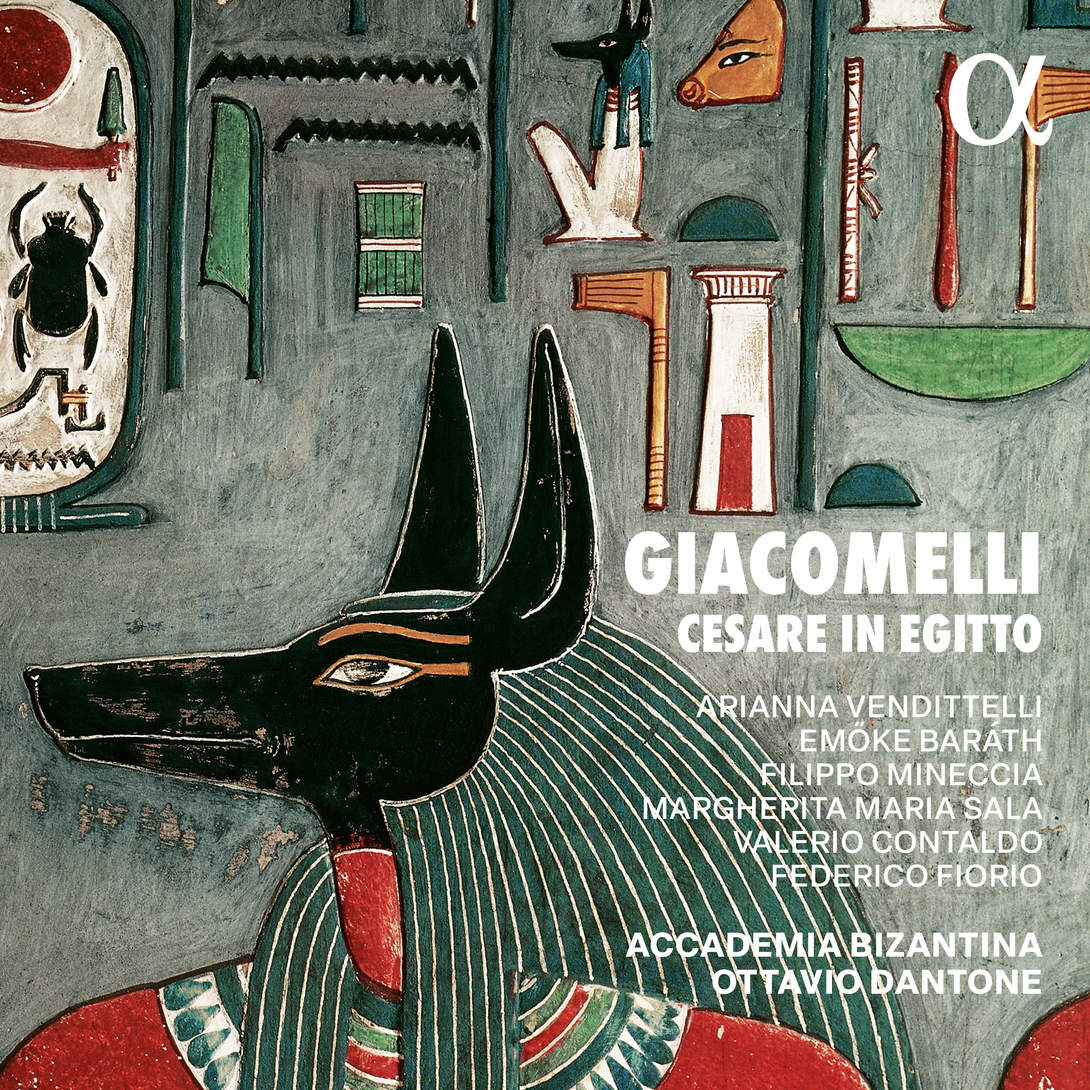
Rediscovered at the Innsbruck Festival under the direction of Ottavio Dantone, Geminiano Giacomelli’s Cesare in Egitto is reborn in a luminous and impassioned interpretation. Backed by Accademia Bizantina, this political and amorous fresco regains all its dramatic power and the nobility of a magnanimous Caesar, embodied by Arianna Vendittelli alongside Emőke Baráth (Cleopatra), Margherita Maria Sala (Cornelia), and Valerio Contaldo (Ptolemy). Released on Alpha Classics / Outhere Music, this live recording, captured in August 2024 at the Innsbruck Early Music Festival, vividly restores both the vitality of baroque theatre and the expressive richness of a composer still too little known.
The intersection of human passions and geopolitical struggles lies at the heart of the story of Julius Caesar. The exploration of jealousy, resentment, vengeance, and the thirst for power that shape this narrative has inspired countless playwrights and musicians. It also animates the cast of this recording, where the ambition and character of each role emerge clearly, along with Giacomelli’s interpretation. Here, Julius Caesar is a hero of radiant nobility. At the end of the drama, his forgiveness and clemency bring together all the characters—including the Egyptians—beyond their past discord. In doing so, Giacomelli follows a common convention of the time: aligning the magnanimity of the protagonist with that of the reigning sovereign.
The live recording of this Cesare at the Innsbruck Early Music Festival (with Ottavio Dantone as musical director) no doubt contributes greatly to the vitality radiating from the result. With its period instruments and long-established expertise in this repertoire, Accademia Bizantina goes far beyond mere authenticity: it ensures that the drama itself remains at the forefront. The sustained rhythmic drive heightens the vocal intensity in the outbursts of anger and love, without losing a shred of precision in the motifs. The clarity of execution offers a full sense of Giacomelli’s musical intelligence, who writes themes that are easily recognizable, seeping into and lingering in the listener’s mind.
Ottavio Dantone’s harpsichord anchors the arias with crisp articulation and invigorating energy. Through its flexibility and finely graded nuances, it also lends the recitatives their psychological depth. Far from being neglected, these recitatives are in fact one of the album’s major strengths. The singers’ diction highlights the text, and their phrasing underscores the intent of every line.
In this respect, Margherita Maria Sala’s Cornelia stands out for her indignation and determination for vengeance, as does the often vicious fury of Valerio Contaldo’s Ptolemy. The choice of soprano Arianna Vendittelli to portray Caesar underscores Giacomelli’s intent to make him a pure and luminous figure. Her airborne high notes confer a near-divine aura on the emperor, while the sustained line of her melodies underlines his integrity. He is thus far removed from any form of brutish virility—an attribute here reserved for Ptolemy. The tenor shapes his singing with this intent, even if his voice occasionally lacks openness in certain arias.
Filippo Mineccia’s vocal opulence fuels the flamboyance of Achillas, boasting an impressive and agile range throughout. The sopranist Federico Fiorio’s tastefully ornamented singing highlights Lepidus’s sensitivity. His celestial, almost perpetually feminine timbre contrasts with the earthy depth of his beloved Cornelia. Emőke Baráth’s rhythmic poise as Cleopatra matches the confidence of a woman assured of her beauty and royal power. Yet she skillfully weaves subtle inflections through this certainty to express the growing anxiety of her fate in Act II.
The quality of the sound recording enhances the instrumental timbres and finely balances the dynamics within the orchestra as well as with the singers. And, as an added bonus for such a rediscovery, the CD booklet includes the complete libretto along with French and English translations.
While it may not quite rival Handel’s musical genius, Giacomelli’s Cesare offers a fully complementary vision of the same historical tale. Its merits are now thoroughly revealed thanks to Accademia Bizantina’s clarity of execution, Ottavio Dantone’s dramatic coherence, and a cast as virtuosic as it is inspired.
Technical Details
Title: Cesare in Egitto (dramma per musica, 3 acts)
Composer: Geminiano Giacomelli (1692-1740)
Libretto: Domenico Lalli, with contributions from the young Carlo Goldoni ; creation: Venice, Teatro San Giovanni Grisostomo, November 24, 1735.
Version: live recording at Tiroler Landestheater (Großes Haus), Innsbruck, August 2024, as part of the Innsbrucker Festwochen der Alten Musik.
Musical direction: Ottavio Dantone
Orchestra: Accademia Bizantina (period instruments)
Cast:
- Arianna Vendittelli — Cesare
- Emőke Baráth — Cleopatra
- Margherita Maria Sala — Cornelia
- Valerio Contaldo — Tolomeo
- Filippo Mineccia — Achilla
- Federico Fiorio — Lepido
Label: Alpha Classics / Outhere Music (3 CDs ; total duration: 2:44)
Notes: Complete libretto included (IT) with FR/EN translations; presented as the first complete world recording.

You must be logged in to be able to post comments.
Sign in