


 A violin and continuo duo—nothing particularly new at first glance! Except when a single musician performs both parts simultaneously…
  By
By 


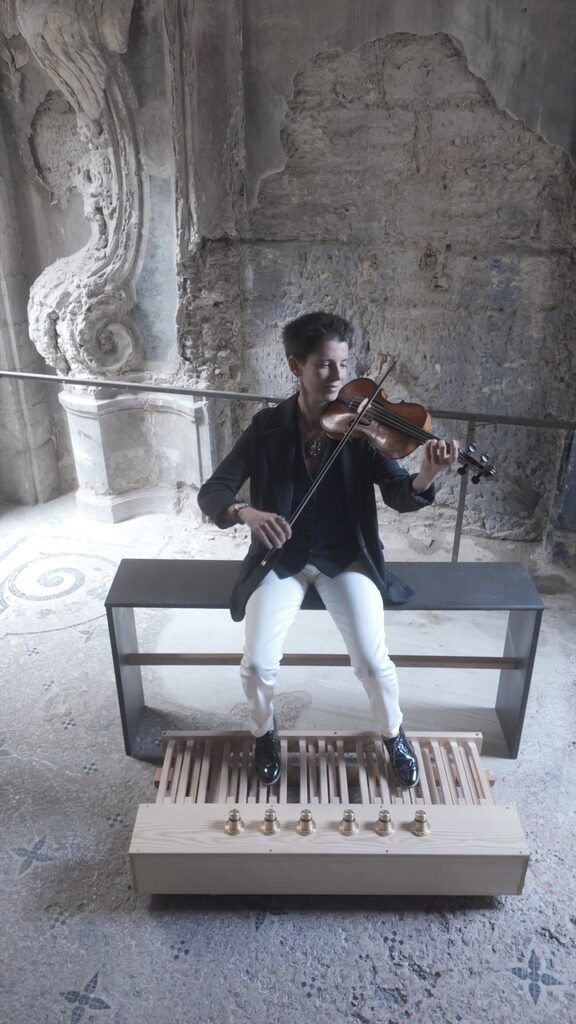
Through her participation in the Biber Competition in St. Florian, Austria, Emmanuelle Dauvin won the opportunity to perform at the Resonanzen Festival in Vienna. She now releases a widely noted second album. The young baroque violinist from Avignon is making headlines, notably for reviving an old practice: playing the violin while accompanying herself on an organ pedalboard.
In OVNI Baroque, you play violin while accompanying yourself on an organ pedalboard—apparently like composer Nikolaus Bruhns did in the 17th century. How did that begin?
Emmanuelle Dauvin: Well, we had an organ at home because my partner was studying organ at the time. I had always thought it would be interesting to rework Biber’s Passacaglia or Bach’s Chaconne this way—to structure them better for myself, to perform them more confidently in concert. I began with that in mind, to prepare a recital—my very first recital in Paris—so I took it very seriously, as you can imagine (laughs)! And actually, while working on Biber’s Passacaglia this way, I realized it sounded really good. I thought about making an arrangement, but I hesitated, as I feared it might distort such a beautiful piece. So instead, I turned to pieces for violin and basso continuo. I began with Biber’s The Annunciation, from the Rosary Sonatas, and it worked really well—the audience loved it! Being able to play continuo parts solo opens up a wide range of possibilities and adds a lot of variety to recordings. I think it’s the combination of all that which motivated me. It wasn’t about doing a solo project just to be solo, but rather about feeling I had something to express with this format, and that I could invent a concert form that resonates today.
Why do you think it works so well?
E.D.: This type of performance gives a piece a very distinct clarity; it’s a stripped-down reading. You hear nothing but Biber’s music, just his bass, often sustained pedal tones, some motion here and there, and ostinato bass lines—hypnotic in their repetition, very bare, very pure… It was incredibly exciting to discover this music in such a simple yet rich way. That made me want to continue exploring. This also creates a very special connection with the audience—they’re a bit surprised by what they see and hear. I love that surprise because it sparks interest: it transforms the way people listen. The connection is a little different.

Passionate about early music and want to read this subscriber-only article?
If you are not a subscriber, join the international Total Baroque community. Subscribe here from 5.00€.
I subscribe
If you are already a subscriber, sign in.
I sign in 


You must be logged in to be able to post comments.
Sign in