


 From statue to living body: based on the myth of Pygmalion, Camille Delaforge brings together two 18th-century French scores, Rameau’s ballet act and an unpublished cantatille by Antoine Bailleux, a contemporary composer who has fallen into oblivion. Performed by Mathias Vidal, this recording uses music to explore the very act of creation.
  By
By 


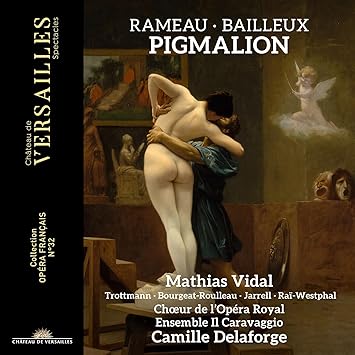
For their sixth album, conductor Camille Delaforge and her ensemble Il Caravaggio take up the myth of Pygmalion (or Pigmalion, in its original spelling), a subject that inspired many composers. The program combines an irresistibly graceful one-act ballet by Jean-Philippe Rameau with a rare cantatille by Antoine Bailleux, a contemporary now fallen into oblivion. Recorded in October 2024 at the Opéra Royal de Versailles, the album features tenor Mathias Vidal, whose sensitivity and delicate tone perfectly capture the doubts and inner turmoil of the mythical sculptor. But the heart of the recording lies in the collective energy: Il Caravaggio unfolds all the richness of its inventiveness and confirms its unique place on today’s baroque scene.
Is this album based on the myth of Pygmalion the result of your personal reflections?
Camille Delaforge: Absolutely. The myth of Pygmalion is inexhaustibly rich for any artist. It questions our relationship with the ideal and with artistic creation: what does it mean to “shape” a work, to breathe life into a project? Taken literally, the myth is problematic—a man sculpts the perfect woman and succeeds in seducing her… It’s worth questioning. But what fascinates me is how Rameau’s music transcends these ambiguities and manages to convey all the energy, fervour, and emotional tension of the characters. We hear the creative impulse, the exaltation of the artist watching his work come alive beneath his hands. That dynamic between art, desire, and creation has always captivated me.
Would you say that, as a conductor, you are a bit like Pygmalion for the orchestra?
C.D.: In a sense, yes. The conductor’s role can resemble that of the sculptor, because one gives shape, guides, inspires. But the orchestra isn’t passive material—it’s a living organism, a collective with its own sensitivity and its own breathing. For me, it’s an ongoing dialogue. Together we sculpt the music, through exchange. Each musician brings their personality and energy, and it’s through that encounter that the score truly comes to life.
You describe this work by Rameau as a masterpiece. Why?
C.D.: Because it encapsulates the very essence of his genius. The orchestration, the harmony, the way the voices and instruments interact—everything is extraordinarily dense. Unlike a three-hour opera, where there are moments to catch your breath, here the intensity is continuous for nearly forty minutes. Each page is a gem that, I believe, can touch even those who are unfamiliar with Baroque music.
On this recording, you introduce listeners to a lesser-known composer, Antoine Bailleux. This seems to be a recurring approach for you. Is that a risk?
C.D.: I don’t see it that way. If I choose a piece, it’s because it excites me and seems worth hearing. I never program a composer simply because he’s “rare,” but because his music has something to say. In this recording, Bailleux’s cantatille is a little gem. These so-called “secondary” composers shed light on giants like Rameau. One better understands a master by placing him in the musical context of his time—by discovering the languages in circulation, the mutual influences. To grasp how our classical musical world was built also means discovering all the composers, not just the famous ones.
Which excerpt would you recommend to a listener who wants to discover the album?
C.D.: I’d suggest the aria Fatal Amour, from Rameau’s Pigmalion. I think it’s the piece that best showcases the composer’s talent. The flute solo, in dialogue with the orchestra and Mathias Vidal’s marvellous voice… Pure enchantment!
 Press review
Camille Delaforge and her ensemble Il Caravaggio approach the score with a deep understanding of Rameau’s colours and treasures of subtlety and energy. […] The icing on the cake: the sound recording is a dream.
Christophe Huss, Le Devoir ( Montréal)
[Camille Delaforge] gives a true masterclass in musical direction: the orchestral material seems moulded from within, and the score appears to come alive before our very eyes! The multiplicity of contrasts and nuances is astonishing, giving the listener the impression not merely of hearing the ballet act in a new light, but of actually accessing the composer’s very intentions through a finely detailed rendering of the score’s intelligence.
Tancdrède Lahary, Forumopéra


You must be logged in to be able to post comments.
Sign in