


 Listening to Bach differently? Lea Suter takes on the challenge with a recording on the clavichord—a quiet yet expressive instrument—for a more intimate take on some of the composer’s most iconic works.
  By
By 


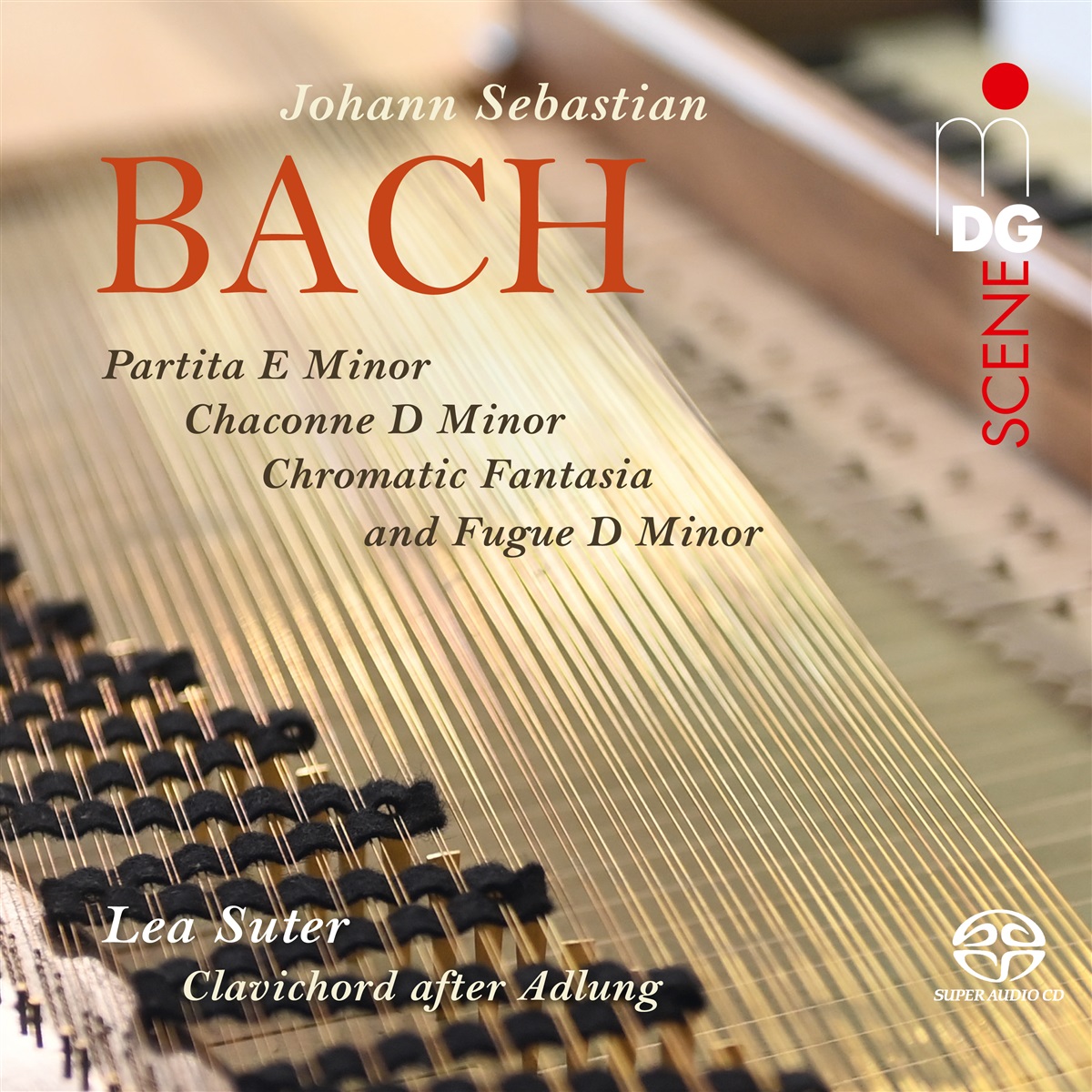
In her new album devoted to Bach, Lea Suter shines a light on a rare and intimate instrument: the clavichord. She performs major works such as the Chromatic Fantasy and Fugue, the Partita in E minor and the Chaconne, delving into the expressive nuances enabled by an instrument that Bach held particularly dear. At the age of sixteen, she built her first clavichord—an experience that marked the beginning of a path shaped by training in organ building and a deep knowledge of early keyboards. A sensitive approach, as close as possible to the music and its emotional essence.
Your recording features some of Bach’s most well-known works, such as the Chromatic Fantasy and Fugue, the Partita in E minor, and the Chaconne in D minor. What inspired you to choose these particular pieces for the clavichord, and how does the instrument reveal new dimensions within them?
My choice was primarily shaped by many years of working with the clavichord—not only as a performer, but also as an instrument maker. Historical instruments can teach us an incredible amount. And I owe a great deal to my teachers, Menno van Delft and Joel Speerstra, who had a profound impact on my approach. Secondly, I explored period sources to better understand the character of different keys and their expressive potential—E minor, for instance, which Mattheson described in 1713 as being rich in dramatic variety. That character is exactly what Adlung was referring to in 1726, when he outlined what he expected from a good clavichord in his time. My instrument is built based on his descriptions. This also coincides with the period in which these works by Bach were composed—during his time in Köthen, and later in Leipzig as Thomaskantor—when his children and probably also his students were learning to engage with music through the Notebook for Wilhelm Friedemann Bach. Bach reworked this collection several times before taking up his post in Leipzig in 1723, and today it is known as the Two- and Three-Part Inventions. In this context, the two Notebooks for Anna Magdalena Bach from 1722 and 1725 are also revealing. They include pieces written not only by Bach, but by his children and others as well. The latter contains the first version of the Partita in E minor—not a beginner’s piece by any means, but one that is dynamic and deeply expressive, as if it were written with the clavichord in mind. All this suggests that, during the 1720s, Bach was reflecting on a method of musical instruction that he considered ideal. This also led me to include the Chromatic Fantasy and Fugue in this recording—a piece that appears in around sixteen surviving copies made by his students. Finally, we should remember that the clavichord was probably the most commonly played instrument in the 18th century. When studying music from the first half of that century, it seems only natural to turn to the clavichord as described by Adlung, in order to better understand the music, the rhetoric, the harmony, the figures, and the sonic language of the time. I believe it’s important to distinguish between clavichords played in the 17th century, those used in the early 18th century, and those of the early Classical period. Trying to grasp that sound language through direct experience with the instrument opens up entirely new perspectives and offers fresh insights into the broader keyboard technique of that time.
The clavichord is renowned for its subtle nuances and even its capacity for vibrato—something very rare among keyboard instruments. How do you make use of these characteristics to convey Bach’s expressive intentions and affective content in your interpretation?
The clavichord demands a completely different mindset from the performer compared to any other keyboard instrument. It calls for absolute focus and a very clear musical and rhetorical idea of what I want to express—otherwise, it simply won’t speak. The vibrato allows for direct influence on the string—not just at the moment of attack or plucking, but beyond that. It adds another layer to sound shaping and serves primarily to prolong the tone. It was mostly Bach’s works for solo violin—such as the Chaconne in D minor—that helped me become aware of this connection to the string and understand musical rhetoric through phrasing, bowing motions (both up and down), and the way motifs are grouped under one stroke. (It’s worth noting that according to a quote from his student Agricola, Bach used to demonstrate his violin works to his students on the clavichord.) The nuances really come from the variety of perspectives that playing the clavichord demands. Like a good storyteller, I have to constantly adapt my mode of expression—otherwise, I become tense and my hand stiffens. Playing the clavichord is like baroque dancing: you’re always striving for lightness, for a sense of floating. But gravity pulls the dancer back to the floor. The more intentionally I make contact with the ground, the more expressive and light my movement appears. Whether it’s a lively, exuberant dance or an elegant, light-footed one, it’s the preparation that ultimately brings out the desired affect.
Compared to other keyboard instruments, the clavichord is less familiar to wider audiences. What challenges and opportunities do you see as a performer to raise awareness and appreciation for the instrument in today’s musical landscape?
The clavichord is perhaps the quietest instrument in our Western musical culture—and for that very reason, it is highly cherished. Audiences love silence, pauses, stillness. But where in our modern lives do we still find that? When I’m lucky enough to perform in a small chapel, a crypt, a 100-seat concert hall, a town hall room, or simply a villa salon, it always creates a very special atmosphere—the audience sits so close. For me, there’s nothing easier than performing a clavichord concert, because from the very first moment, the audience is silent and completely focused—precisely because the instrument is so soft. Together, we enter a state of shared concentration. Where else can we still experience that today? And what could be more precious than this intimacy and focused listening experienced live? If we ask ourselves the essential question: what can music—or art more broadly—do? It can inspire the listener to refocus, to reconnect with what truly matters, through all the senses. That’s why I find the clavichord so essential to modern concert life. After one performance, someone told me: “You’re selling silence with the clavichord.” I’ve never known another concert format where the audience expresses such gratitude afterward—for a moment that, in truth, they helped create themselves. I always bring the clavichord with me to concerts and usually travel by train. Joris Potvlieghe built me a particularly lightweight instrument, with which I’ve already travelled to the Swiss Alps, Italy, Belgium, and as far as Norway. So no, there haven’t really been any obstacles. The concerts have always been well attended, and the audience wonderfully curious.
 Press review
“Johann Sebastian Bach owned a [clavichord]: many of his works that are now performed on the harpsichord or piano were likely first heard on this instrument, where music in a minor key takes on particularly vivid and expressive colours. Lea Suter performs two major works with remarkable vitality and a strong sense of narrative: the Partita No. 6 in E minor, BWV 830, and the Chromatic Fantasy and Fugue in D minor, BWV 903. Listening on headphones heightens the intensity even further. Violin works can also be transposed to the instrument, as Suter demonstrates with the grand Chaconne from the Partita for solo violin, BWV 1004. Both the work and the instrument stand the test brilliantly”
Sebastian Loskant, Bremen News
“Sensitive. Subtle. Profound. [Lea Suter] has a deep affection for the instrument and, in her new recording, reveals the clavichord’s full palette of tonal and emotional nuance. She demonstrates how its expressive potential can be used to the fullest, breathing new life into works such as the Chromatic Fantasy and Fugue, the Partita in E minor, and the famous Chaconne for violin – here performed in a keyboard transcription. Even in conventional stereo, her performance captivates. But in three-dimensional 2+2+2 playback, it unfolds into a sonic world that is both refined and richly textured, drawing the listener in with irresistible immediacy.”
CLASS:aktuell, Lisa Eranos


You must be logged in to be able to post comments.
Sign in