


 In their new album, French ensemble La Néréide imagines the voice of a young maiden at the 17th-century Saint-Cyr boarding school, reflecting the era’s conflicting impulses between religious conduct and earthly sensuality.
  By
By 


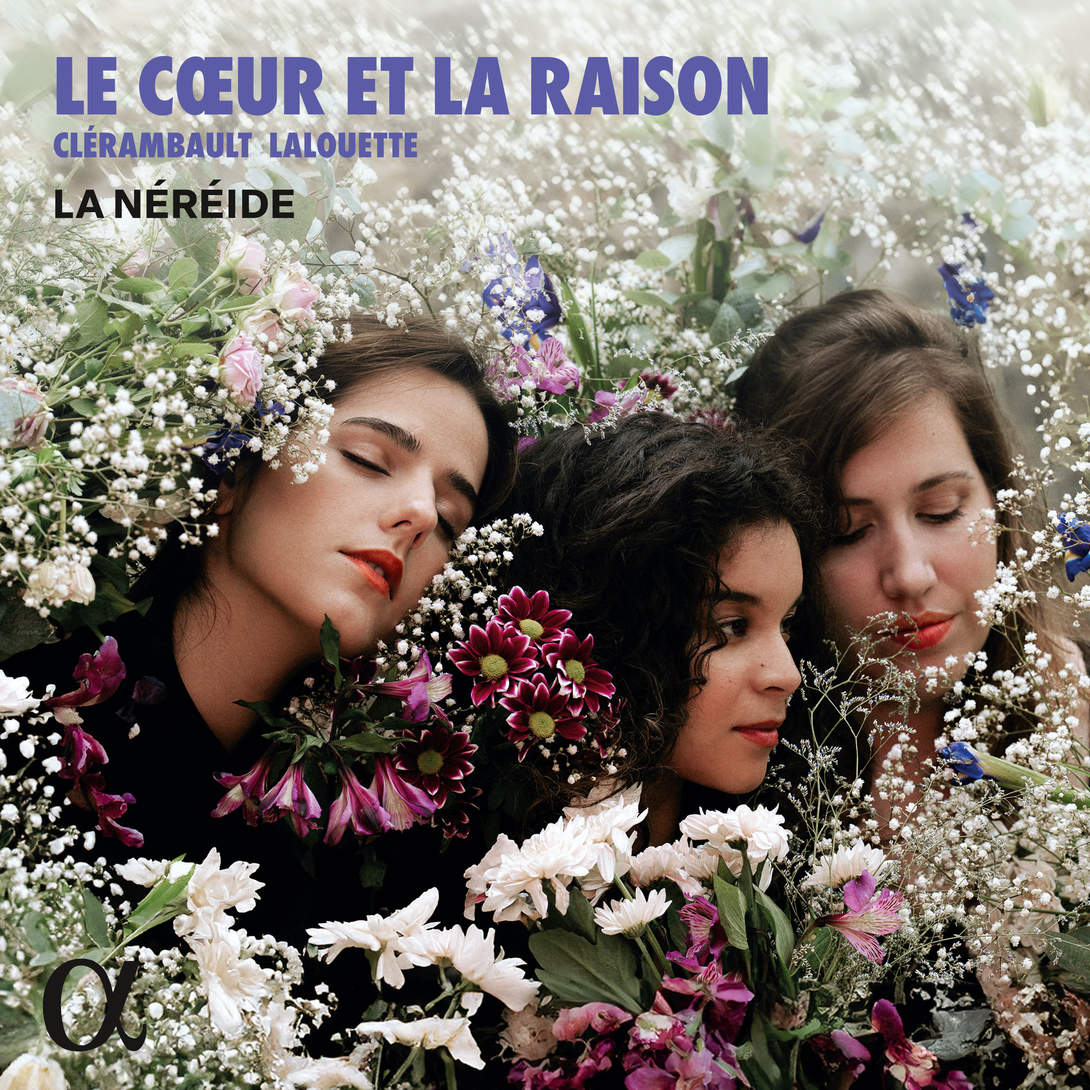
The voices of Julie Roset, Camille Allérat and Ana Vieira Leite (La Néréide) bring to life Le cœur et la raison, released in August. The album sketches the imaginary portrait of a pupil at Saint-Cyr [the royal institution for the education of young noblewomen], torn between devotion and desire, through 17th-century court airs and motets, some transposed from the secular to the sacred by the art of parody. From the very first notes unfolds a narrative of striking coherence, where history and our own sensibilities converge. Emmanuel Arakélian (organ), Salomé Gasselin (viola da gamba) and Miguel Henry (theorbo) provide the accompaniment.
How did you translate this contrast between “heart and reason” into the musical staging of the album?
Julie Roset: In order to distinguish between the two dimensions—heart and reason—we opted for distinct repertoires: the court airs embody the expression of the heart, while the Miserere illustrate the rigour of reason. This differentiation is also expressed through the instrumentation: the viola da gamba and theorbo, associated with the secular register, give the pieces a particular intimacy, while the gallery organ, reserved for sacred repertoire, introduces a more solemn gravity.
Camille Allérat: As Julie said, the repertoire itself induces this dichotomy: the subtlety lies in the fact that it is both a story of opposition and harmony, since these feelings are all united in a single female figure. The story we want to tell is ultimately how each and every one of us manages to reconcile such different feelings throughout our lives, with all that this sometimes entails in terms of pain or great joy.
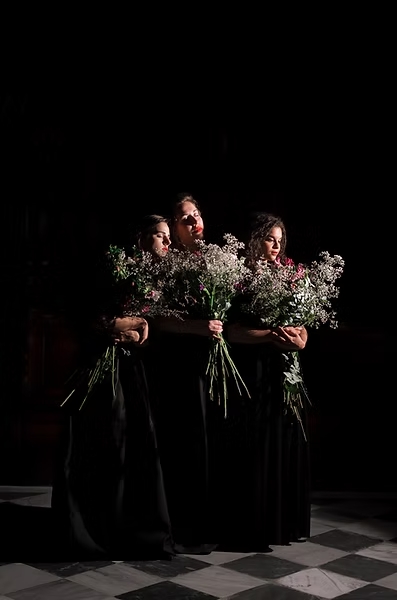
Ana Vieira Leite: We also wanted to convey this tension in the visual aspects of the album and its promotion: for the heart, a bright and gentle universe that invites romantic reverie, and for reason, a nocturnal and mysterious atmosphere that calls for spirituality. To tie it all together, a wide variety of flowers surround the faces and bodies, symbolizing all of these aspects at once: awakening to sensuality, romanticism, purity, contemplation, joy, and delicacy.
The album juxtaposes refined courtly airs with their religious versions adapted by Father François Berthod. What do you think this movement between the secular and the sacred brings to the listening experience?
Julie: I love that Father Berthod so appreciated the court airs that he decided to rewrite their texts (thus creating spiritual parodies). In this way, he ensured that everyone could enjoy the beauty of this music while singing words consistent with the values of the Church. You could say it was an ingenious and benevolent way to reconcile musical pleasure with spirituality, and that is why we used these spiritual airs as a bridge between the sacred and the profane.
Camille: There is also a certain irony in this process of spiritual parody: in my opinion, the sensuality that Father Berthod criticized in courtly songs is expressed not only in the lyrics but also in the music itself. It’s amazing what you can feel when you listen to them or sing them! So I’m not sure that replacing the original lyrics with more “appropriate” ones can really make us forget the powerful romantic melancholy of these pieces. I rather have the impression that it was a way of saving face in the eyes of the church and the royal authorities, who were responsible for the good behavior of the residents of St-Cyr.
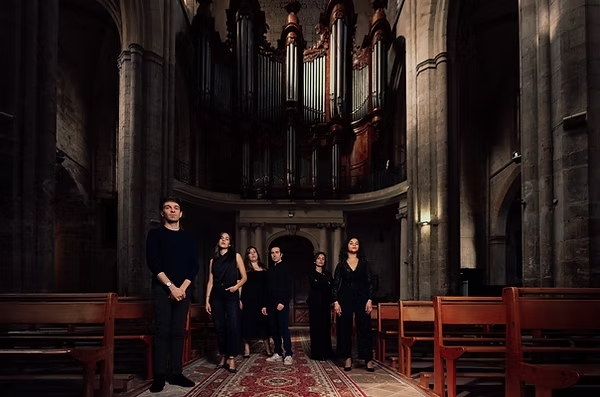
Ana: More broadly, bringing together within a single album two repertoires that are, in theory, radically opposed allows, I believe, the listener to have a more varied and accessible listening experience. One can be shaken by the extreme dissonances of Clérambault’s Miserere, then enjoy the chiaroscuro colours of the secular airs before diving back into the never-before-recorded pages of Lalouette’s Miserere… It seemed important to us to offer as wide a musical palette as possible while remaining faithful to a period so rich in masterpieces.
With this album, which is more introspective and dramatic than your previous one, Luzzaschi: Il concerto segreto, what do you wish to share with the listener?
Julie: Creating stories around women is truly close to our hearts. That is how we met and decided to found the ensemble around Clérambault’s Miserere, choosing to place this work at the centre of our album. Musically, this program is deeper and less lighthearted than Luzzaschi, which evoked spring and the affects of love. Here, Le Cœur et la Raison explores a deeper intimacy, with works that allow us to highlight a different and more nuanced vocality.
Camille: Indeed, it was Clérambault’s Miserere that enabled the real meeting of our three voices in 2019, and that led to the decision to create La Néréide. For us, this represents the fulfillment of a shared desire rooted long ago, and several years of work. So beyond sharing this sublime music, this second album also represents the sharing of quite a large part of our identity as an ensemble!
Ana: To conclude, what we wish to reveal in this second album is both our love for this delicate, precious, and yet so intense French music, and also the story of this young girl we are trying to imagine and understand. Since love is something perfectly universal, I believe everyone can identify with her inner struggles and feel very personal emotions while listening to this album.
Which piece best illustrates, in your view, the existential distress experienced by this imagined young girl?
Julie: For me, the final piece of the album, “Laisse-moi soupirer”, along with “Sombres déserts”, perfectly reflects the confusion of this young girl, torn between her deep emotions and the strict environment around her. In “Sombres déserts”, she seeks refuge in nature to do penance, because worldly settings exacerbate feelings that cause her anguish. Laisse-moi soupirer is the girl’s ultimate plea to reason, to those around her, asking to be given time to live out her first emotions and to discover herself fully.
Camille: I think there is a real dialogue between the first piece of the album and the last, which Julie mentioned. The first, “Je ne sais pas ce que je sens”, is for me the most representative of that disorientation we have all felt one day when falling in love—that absolute loss of bearings which is at once the greatest heartbreak and the greatest joy. I would even say that everything is in the title!
Ana: While it is true that the court airs are particularly poignant and speak directly to the heart (helped, of course, by the fact that they are in French), I find that Clérambault’s Miserere but also Lalouette’s express very clearly the existential tug-of-war of our young girl. One hears it musically in the striking dissonances of both scores, and also in the sometimes very joyful passages of these pieces. The liturgical texts themselves ultimately speak of this opposition: between the imploring plea for forgiveness in “Miserere mei Deus” [“Have mercy on me, O God”] and the desire to find joy in “Auditui meo dabis gaudium et laetitiam” [“Grant my ears joy and gladness”], one can also grasp the thousand shades of human emotion.
 Press review
Three voices which, as they intertwine and merge, succeed in creating sound textures of striking richness and sensuality.
Laure Mézan, Radio Classique
The three soprano voices blend beautifully and find their finest moments in the Airs sérieux, carried by the delicate accompaniment of viola da gamba and lute.
Bernhard Schrammek, Radio 3


You must be logged in to be able to post comments.
Sign in