


 Between choral breadth and chamber-like intimacy, Jeannette Sorrell refuses to choose. With Apollo’s Fire and a compact choir of twenty-two singers, the American conductor delivers a luminous and vital “Mass in B minor”, bringing the voices into close focus without diminishing the power of the great choruses.
 By
 2 minutes


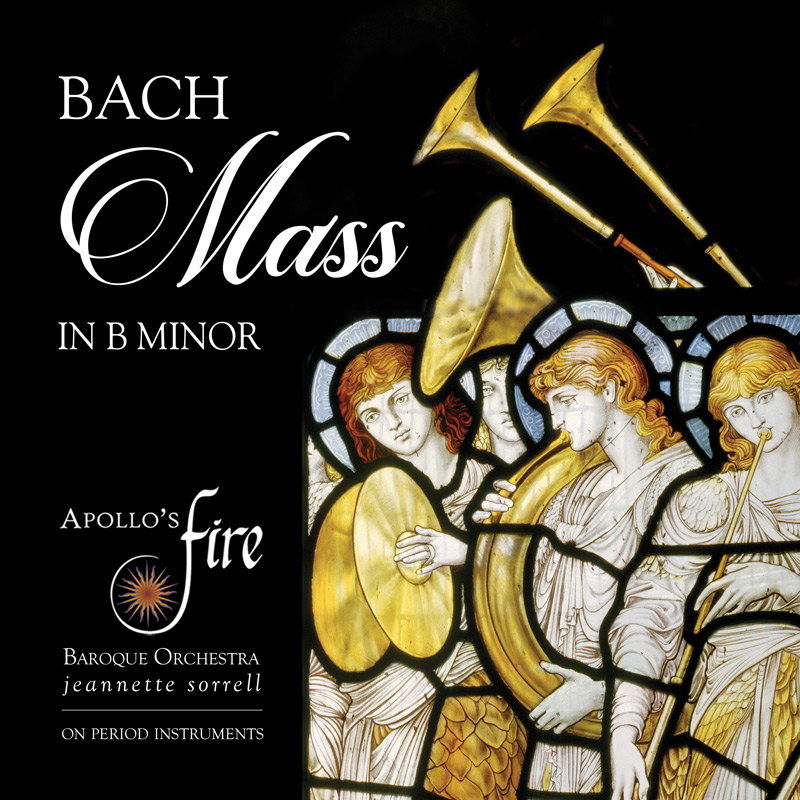
Released on October 23 by Avie Records, this new complete recording of Bach’s Mass in B minor was made in April 2025 at Trinity Cathedral in Cleveland. With Apollo’s Fire and the Apollo’s Singers, Jeannette Sorrell brings together Rebecca Myers, Aryssa Leigh Burrs, Emily Marvosh, Jacob Perry, Edward Vogel and Paul Max Tipton. The recording crowns a series of performances in Cleveland and Chicago, after years during which Sorrell says she deliberately postponed taking on this monumental work.
Neither monument nor miniature
The size of the forces already says much about this interpretation. Sorrell uses twenty-two singers, roughly four to a part in the five-part movements, drawing on the forces Bach requested from the Leipzig Town Council. Yet the result is compelling for reasons that go well beyond historical considerations. The Apollo’s Singers have enough body to give the great choruses their power while allowing the counterpoint to breathe. From the opening Kyrie, individual lines remain distinct without weakening the density of the supplication; in the Gloria and Cum Sancto Spiritu, precision never comes at the expense of momentum.
This lightness is one of the album’s real pleasures. Sorrell constantly hears the dance that runs through the score: rhythms retain their spring, articulation its directness, and the most brilliant episodes avoid the monumental weight that can sometimes make the work feel static. The trumpets bring all their brilliance to the Gloria and Et resurrexit without overwhelming the voices. At the opposite extreme, the Crucifixus suddenly contracts the sound world before the resurrection bursts forth, all the more effectively because the contrast has not been overstated.
Soloists within the orchestral fabric
The six soloists fit naturally into the overall texture. Rebecca Myers and Jacob Perry find an especially happy accord in the Domine Deus, marked by simplicity and attentive interplay. Darker in tone, Emily Marvosh approaches the Agnus Dei with restraint, sustained by a long, carefully shaped vocal line. Edward Vogel brings a supple and serene line to the Et in Spiritum sanctum. More spectacularly, the Quoniam allows Paul Max Tipton to establish a firm presence in a movement whose unusual combination of low voice, corno da caccia and bassoons emerges with particular relief.
For her part, Jeannette Sorrell handles Bach’s shifts of scale with care and intelligence. The contrast is especially striking between the spareness of the Benedictus, reduced to tenor, flute and continuo, and the breadth of the double-choir Osanna. These changes of scale give the Mass a remarkably clear sense of breathing, continually renewing the pleasure of listening. Sorrell also guides the work towards an ever broader final affirmation, carefully husbanding its effects until it reaches a fullness that seems earned over the course of the journey rather than imposed from the outset.
In a discography where the most contrasting interpretative choices have long found their advocates, this new Mass in B minor succeeds through its balance and the directness of its approach: spectacular without being emphatic, and consistently allowing clarity of line to serve the emotion.



You must be logged in to be able to post comments.
Sign in