


 On the occasion of the tenth anniversary of the Spanish ensemble Concerto 1700, conductor Daniel Pinteño looks back on a journey fuelled by curiosity, musicological commitment, and an enduring love for Spanish Baroque music.
  By
By 



Daniel Pinteño founded Concerto 1700 to champion the Baroque repertoire of his homeland, Spain, which was still largely unknown. A decade later, his ensemble stands as one of the most committed forces on the Spanish scene. A look back at a musical adventure shaped by scholarship, artistic freedom, and collective passion.
You founded Concerto 1700 ten years ago with the aim of championing a Baroque repertoire that was still largely unfamiliar. If you had to recount that beginning today, what memory or founding intuition comes to mind?
Daniel Pinteño: I couldn’t say exactly when it all began, because it was an idea I’d been mulling over for several years. The real trigger came during my final year at the conservatory, in February 2015. At the time, I was entirely focused on my graduation recital at the Real Conservatorio Superior de Música de Madrid, where I was studying Baroque violin with Hiro Kurosaki. Even though I was already freelancing with several early music ensembles in Spain, I felt the urge to embark on a personal project. Creating a space where I could explore different types of repertoire from my own perspective and give free rein to my creativity seemed like a natural next step!
That’s a desire shared by many artists, but it’s much rarer for someone to actually make it happen… In your case, it seemed almost irrepressible.
D. P.: Yes! Since childhood, I’ve always loved venturing down less-traveled musical paths. During my training years, I gathered many reasons to set out on an adventure like Concerto 1700. And those who know me will tell you I’m a pretty impulsive person (laughs)… That impulsiveness, combined with a strong curiosity, was probably the seed of this ensemble that is now such an integral part of my life.
Why did you choose the name “Concerto 1700”?
D. P.: One of the first decisions once the project began was choosing the name—which is never easy. In my case, “Concerto 1700” came from the combination of two ideas. On one hand, there’s the word “concerto” in its classical sense, but I also like its Italian origin, concertàre, which is very close to the Spanish concertar, evoking debate and consensus. On the other hand, the number 1700 marks a balance point between the 17th and 18th centuries, and also a musical turning point for me: the publication of Arcangelo Corelli’s violin sonatas, Opus 5. Their release on January 1st, 1700, marks a milestone that every early music specialist should remember!
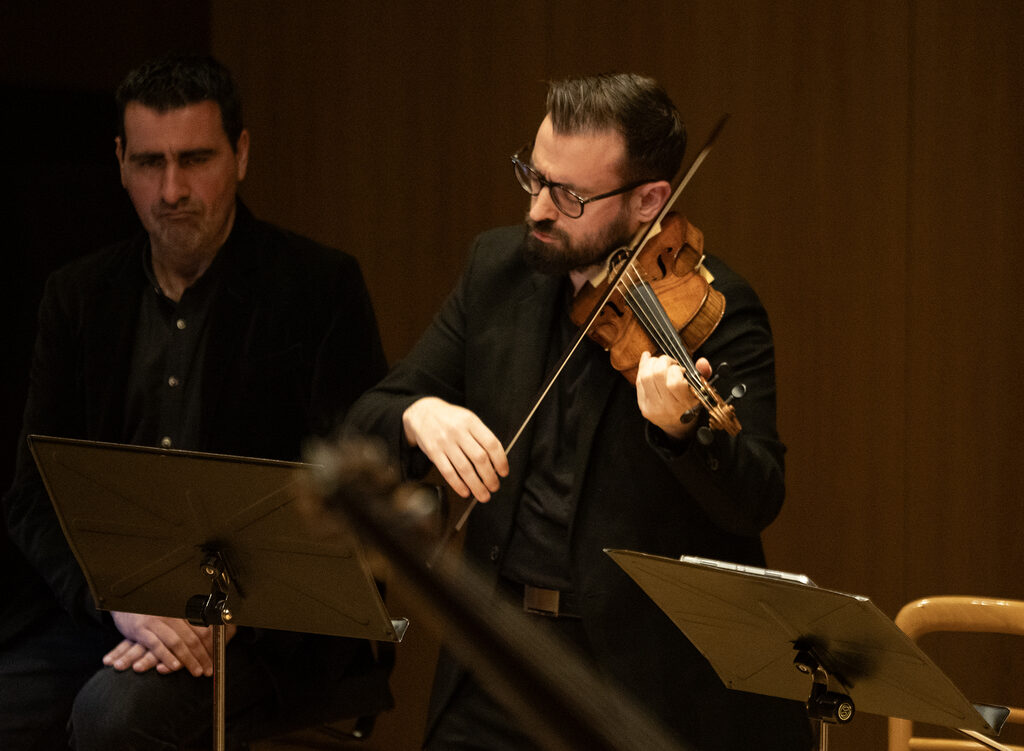
In ten years, the ensemble has established itself as one of the major voices of Spanish Baroque. How would you describe your evolving relationship with this repertoire?
D. P.: I grew up alongside this repertoire, learning and leaning on the work of musicologists—without whom our rediscovery efforts would be impossible. There’s something thrilling about playing music that’s lain forgotten for 250 or 300 years somewhere in the archives. You often stumble upon real gems! We began with the cantada—what other countries call the cantata. In Spain, this genre has very distinctive traits and underwent a fascinating Italianization in the early 18th century. Recording our album dedicated to Antonio Literes’ cantadas with countertenor Carlos Mena allowed us to clearly illustrate this evolution—from a more Hispanic structure combining basses, coplas, recitatives, and arias, to forms influenced by the Italian style of the 1730s. Then we branched into other directions, like multidisciplinary projects with dancers or actors, and chamber music, doing deep work on previously unrecorded works by José Castel and Gaetano Brunetti, to whom we’ve now dedicated three albums.

Passionate about early music and want to read this subscriber-only article?
If you are not a subscriber, join the international Total Baroque community. Subscribe here from 5.00€.
I subscribe
If you are already a subscriber, sign in.
I sign in 


You must be logged in to be able to post comments.
Sign in