


 A Portuguese company is offering to provide programme notes written by Artificial Intelligence. The verdict?
  By
By 



Artificial intelligence is on everyone’s lips these days—and is being used for all kinds of tasks, sometimes the most absurd. But most of all, it’s being used for writing. The problem is, you never quite know when it’s going to start “hallucinating”. The fact that AI tools like ChatGPT only know what they’ve been trained on (and their raw material is the internet) is another limitation. In a niche domain such as classical music—and even more so early music—producing texts that are both accurate and well-written is often next to impossible. At least, until now. A young Portuguese company intends to change that: it has launched Classical Notes, an AI program that generates programme notes for musicians and concert organizers. Does it work?
“Honestly, I struggle to imagine us turning to AI for our programme notes,” confides Ludwig Hartmann, one of the artistic directors of the Tage Alter Musik Regensburg, a festival renowned for its off-the-beaten-track concerts and carefully crafted booklets. “We usually get good content from the artists and agencies. When that’s not the case, we work with the University of Regensburg, with the Institute of Musicology, which provides us with high-quality material. So far, the AI-generated texts I’ve read don’t meet those standards.”
But not every festival or organizer has such resources. And not every musician enjoys writing. Let’s face it: not everyone has a talent for it either…
So, what’s the solution? Henry Ferro, a programmer at Catalyst Music, a Portuguese company specializing in career development and communication for musicians, had an idea: an AI tool that writes texts on their behalf. “Originally, we just wanted to help musicians solve this problem, because they’d rather spend time playing than writing. We thought it might interest a few friends or clients,” he recalls.
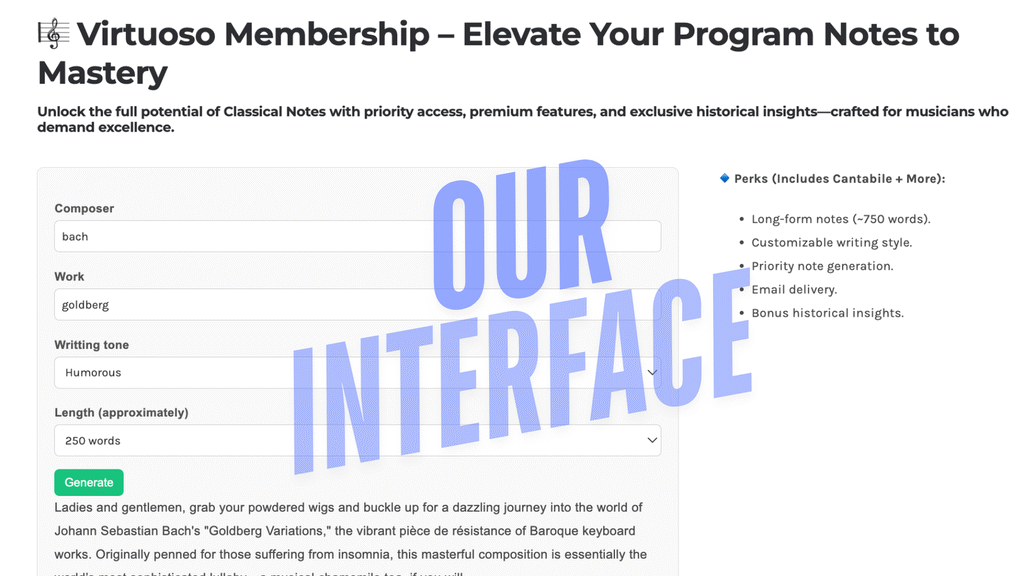
With Classical Notes, available online since February, you simply have to complete a form with just a few details (composer’s name, work title) and seconds later, a text appears, in the language, style and length of your choice. To achieve this, the team developed a language model—similar to ChatGPT—fine-tuned to produce texts suited to the classical music world, Ferro explains. “We also worked on style and tone: depending on the user’s needs, the text can be written in academic, dynamic, or narrative style.”
Passionate about early music and want to read this subscriber-only article?
If you are not a subscriber, join the international Total Baroque community. Subscribe here from 5.00€.
I subscribe
If you are already a subscriber, sign in.
I sign in 

You must be logged in to be able to post comments.
Sign in