


 “I was born free, I have lived free, and I will die free.” The French ensemble L’Escadron Volant de la Reine has taken Queen Christina of Sweden’s famous motto to heart, imagining the Requiem she never commissioned and performing it in the Roman church where her funeral took place in 1689. A portrait of an ensemble that thrives on contrasts, performing everywhere from the French countryside to stages across Europe.
 By
 9 minutes


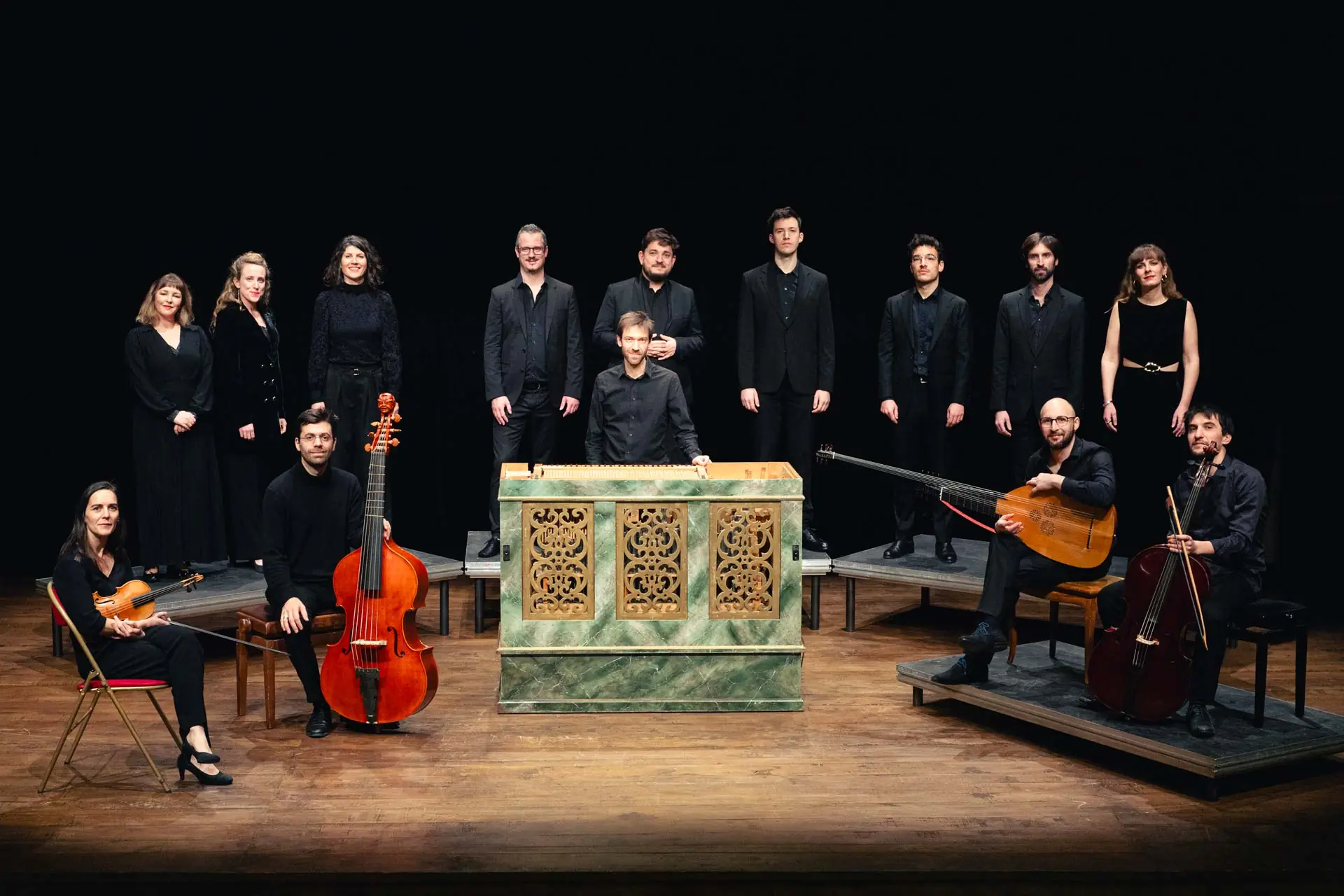
Rooted in the Perche region, between Normandy and the Loire Valley, while touring throughout France and Europe, L’Escadron Volant de la Reine explores forgotten and little-known repertoire from the Baroque era. Founded in 2013 by Antoine Touche, the ensemble was selected that same year for the International Young Artists Presentation in Antwerp and won both First Prize and the Audience Prize at the 2015 International Val de Loire Competition, chaired by William Christie. Conceived as a collective, the ensemble takes its name from the group of ladies-in-waiting who accompanied Catherine de’ Medici on her travels. To mark the 400th anniversary of the birth of Christina of Sweden, the queen born in 1626 who left a lasting mark on Rome’s musical history, L’Escadron Volant de la Reine has imagined a ceremony for her funeral. Josèphe Cottet, a Baroque violinist and violist, and Clément Geoffroy, a harpsichordist and organist, introduce this program, entitled Liberata!
Your ensemble’s name evokes not Christina of Sweden, but another queen: Catherine de’ Medici. Is she an important figure for you?
Josèphe Cottet: In terms of historical periods, the connection only goes so far: Catherine de’ Medici (1519–1589) belongs to the Renaissance, long before the music we play and long before Christina of Sweden (1626–1689)! What initially appealed to us was the idea of the escadron, or squadron. The Escadron was a group of women surrounding Catherine de’ Medici whose role was to spread culture throughout the European courts. That was what resonated with us: forming a kind of small swarm of musicians who would each, in their own way, without a hierarchy but with a certain degree of organization, go out and make music everywhere.
Clément Geoffroy: People immediately talk about spies, but I think “ambassadors” is a better term, because anyone who traveled in those days was something of both a spy and an ambassador. For culture to circulate, people had to experience it and bring it back with them. Musicians traveled to different courts and returned with what they had heard.
So the ideal of spreading culture lies at the heart of your ensemble?
J. C.: Yes, on two very different levels. We do a great deal of work bringing music to audiences by performing all over France and Europe, but also on a much more local scale, from our “base camp,” which is enormously important to us. That is what makes us think about how to bring culture to people and how to put that into practice: how do you establish yourself in a particular area? What does the audience expect? How do you engage an audience that knows little or nothing about this music? How do you make it entertaining? You have to know how to adapt to that more local level, whereas when you are invited somewhere where all of this is already taken for granted, you can offer something more ambitious.

Passionate about early music and want to read this subscriber-only article?
If you are not a subscriber, join the international Total Baroque community. Subscribe here from 5.00€.
I subscribe
If you are already a subscriber, sign in.
I sign in 



You must be logged in to be able to post comments.
Sign in