


 In Bayreuth and across Franconia, the 2026 edition of the Gluck Festival explores a body of work at the crossroads of styles, between the last embers of the Baroque and the birth of Romanticism. At its helm, conductor Michael Hofstetter sketches the portrait of a forward-looking musician whose legacy—claimed alike by Berlioz and Wagner—has left a lasting mark on the musical world.
  By Roland H. Dippel


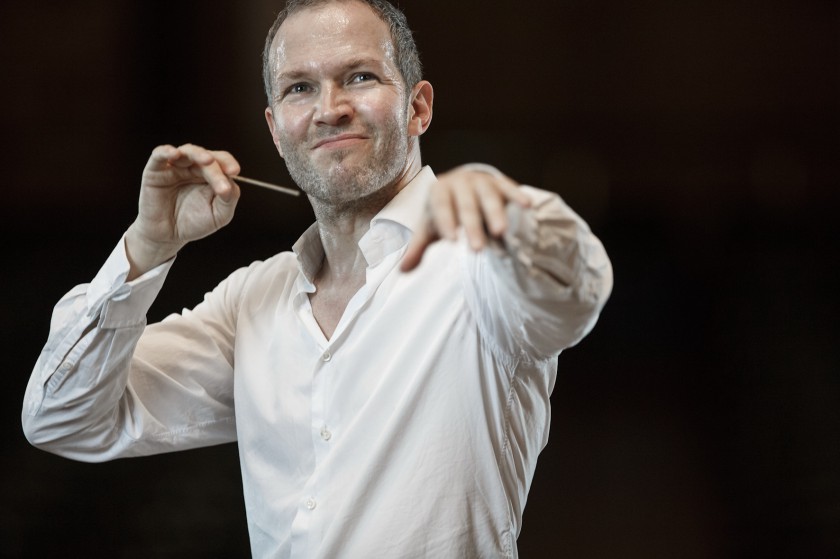
As a conductor, Michael Hofstetter approaches early music with passion but without dogmatism. His recordings of operas such as Didone abbandonata by Hasse and Oberon by Weber have surprised listeners with their fury and power. Since 2022, he has been Artistic Director of the Gluck Festival (Gluck-Festspiele), while maintaining a busy schedule as a guest conductor with opera houses and specialised ensembles. The Gluck Festival takes place in the Nuremberg region of Bavaria, across venues ranging from Berching, the composer’s birthplace, to the Margravial Opera House in Bayreuth. This year, the German conductor has chosen as his theme “The Discovery of Romanticism on the Operatic Stage”, with particular reference to the 150th anniversary of the Bayreuth Wagner Festival, in the summer of 2026. Three operas will be presented: Orphée after Hector Berlioz (Paris, 1859), Iphigenie in Aulis in the adaptation by Richard Wagner (Dresden, 1847), and the original version of Paride ed Elena (Vienna, 1770).
At the 2024 edition, you set Gluck’s La clemenza di Tito (Naples, 1752) alongside Mozart’s, composed forty years later (Prague, 1791). This year, you’re looking at Gluck as a pioneer of musical theatre in the context of the 19th century: between the late Baroque and the early Romantic movement, where would you place him? The question is all the more pressing in Bayreuth, the festival’s location, in the long shadow of Richard Wagner, who was, as we know, a great admirer of Gluck…
Michael Hofstetter: Of course, the idea for this programme also arose thanks to the Margravial Opera House in Bayreuth. This venue, which is important to us, is both geographically and thematically close to the 150th anniversary of the Bayreuth Wagner Festival, which begins ten weeks after our Gluck Festival. It is a major event. At first glance, this may seem contradictory, but it in fact highlights the energies emanating from Gluck towards the nineteenth century.
You are a specialist in eighteenth-century music. How do you situate Gluck, this “non-classicist”?
M. H.: I distance myself from Gluck’s aesthetic and dramatic positioning in the eighteenth century. Certainly, the masterpiece Orphée, in its three versions for Vienna, Parma, and Paris, is already essential, even without the admiration of Richard Wagner, Hector Berlioz, and others. But with his forward-looking formal and structural innovations, Gluck transformed the international musical theatre of his time. He established major models for the future. Gluck turned his gaze inward, into the deepest recesses of the soul. One reads it in the scores and hears it. The archetypes defined by Carl Gustav Jung, such as the “Shadow,” as well as the concept of the “collective unconscious,” are perfectly recognisable in him. In the overture and in the Furies scene of Orphée, for example, he anticipates what Jung would later theorise. This cannot be described or grasped using the concepts and language of the eighteenth century.
Passionate about early music and want to read this subscriber-only article?
If you are not a subscriber, join the international Total Baroque community. Subscribe here from 5.00€.
I subscribe
If you are already a subscriber, sign in.
I sign in 
You must be logged in to be able to post comments.
Sign in