


 Led by Collegium 1704 and Václav Luks, this recording brings together Jan Dismas Zelenka’s “Missa Circumcisionis” and “Missa Corporis Domini”, two works distinguished by the richness of their orchestration, in a style often compared to that of Johann Sebastian Bach. A new milestone in the discography of the Czech composer, delivered with rigour and commitment.
  By Rashid-S. Pegah


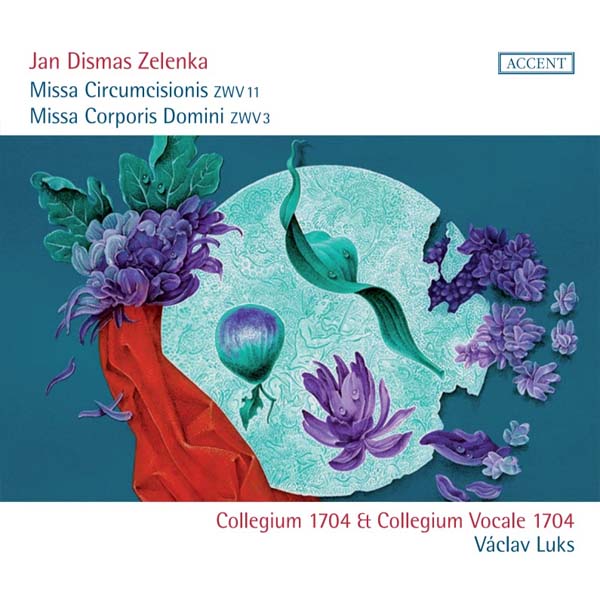
The fact that Jan Dismas Zelenka (1679–1745) has once again become a fixture in today’s musical landscape is owed, above all, to Czech ensembles specializing in early music. First and foremost, to Collegium 1704 and Václav Luks. Their latest release on ACCENT, the recording of the Missa Circumcisionis and Missa Corporis Domini, once again highlights the distinctive compositional style of the Dresden church composer and double bassist.
Born in Bohemia in 1679, Jan Dismas Zelenka, however, spent most of his career in Dresden. There, he progressed from the position of double-bass player and composer in the Hofkapelle to that of court church composer. His life and activity in the Augustan “Florence on the Elbe” were long regarded as marked by setbacks and disappointments. More recent research, however, has shown that he enjoyed great esteem and genuine recognition there—even if this did not necessarily translate into spectacular advancement in his career.
As early as the nineteenth century, his singular musical language was compared to that of Johann Sebastian Bach. Zelenka developed a remarkable synthesis between contrapuntal writing, the more recent Neapolitan style, and older models dating back to the early seventeenth century. It was notably with Johann Joseph Fux, Imperial Kapellmeister, that he deepened his mastery of counterpoint and enriched his knowledge of earlier repertoires. Zelenka followed his teaching in Vienna around 1718.
His masses themselves rest on the articulation of late Baroque, galant, and contrapuntal styles. These works occupy a central place in his catalogue. Two of them—the Missa Circumcisionis ZWV 11 and the Missa Corporis Domini ZWV 3—are presented here by Václav Luks, at the head of his ensembles Collegium Vocale 1704 and Collegium 1704, surrounded by carefully chosen soloists. Composed for New Year’s Day 1729, the Missa Circumcisionis stands out for its rich orchestration, dominated by three trumpets, timpani, and a pair of horns. Zelenka makes extensive use of these brass instruments throughout the work. In the “Qui tollis peccata,” he pairs the soprano and alto soloists with a violin and an oboe, to which the instrumentalists of Collegium 1704 (Konzertmeisterin Helena Zemanová and oboist Katharina Andres) make a remarkable contribution. As a quartet, the vocal soloists’ timbres blend with striking harmony. Only Aneta Petrasová’s alto voice sometimes seems a bit faint. The sudden shift in emotion in the “Qui sedes ad dexteram Patris,” however, is admirably executed by the entire ensemble.
The Missa Corporis Domini has come down to us without a Gloria. Zelenka composed it around a decade before ZWV 11. From the opening “Kyrie eleison,” constructed as a passacaglia, he skillfully unfolds a motif treated in contrapuntal imitation. In the Credo, a passage in the minor mode introduces an almost dramatic contrast. For the “Crucifixus,” with its steady movement, he calls for four basses, whose timbres, in this interpretation, blend with fine homogeneity. In the “Benedictus,” a bass solo once again accompanied by violin and oboe, Tomáš Šelc proves himself superior to Tadeáš Hoza. Hoza performs the “Confiteor,” which, as Václav Kapsa rightly notes in the program notes, would long since have become a hit had it been a bass aria from an oratorio by George Frideric Handel (1685–1759).
Overall, the musicians under Václav Luks once again confirm their excellence, with only occasional reservations regarding expressive intensity. Nevertheless, the ensemble offers a reading of great poise, one that brings out the richness and singularity of Jan Dismas Zelenka’s writing—a recording to be recommended without hesitation!
Technical details
Works: Missa Circumcisionis ZWV 11, Missa Corporis Domini ZWV 3
Composer: Jan Dismas Zelenka (1679–1745)
Dates of composition: 24–28 December 1728 (ZWV 11), c. 1719 (ZWV 3)
Recording: studio recording, St Anne’s Church, Prague, May 2025
Musical direction: Václav Luks
Choir: Collegium Vocale 1704
Orchestra: Collegium 1704 (period instruments)
Soloists:
- Tereza Zimková – soprano
- Aneta Petrasová – alto
- Rodrigo Carreto – tenor
- Tomáš Šelc – bass
- Tadeáš Hoza – bass
- Martin Vacula, Josef Kovačič – basses (choir soloists)
Label: ACCENT (ACC 24416) / note 1 music gmbh (1 CD, total duration: 61:44)

You must be logged in to be able to post comments.
Sign in