


 Discovering an unjustly overlooked St. John Passion, brought to life by Ensemble Polyharmonique and conductor Alexander Schneider—a polyphonic journey into the dawn of the German Baroque!
  By
By 


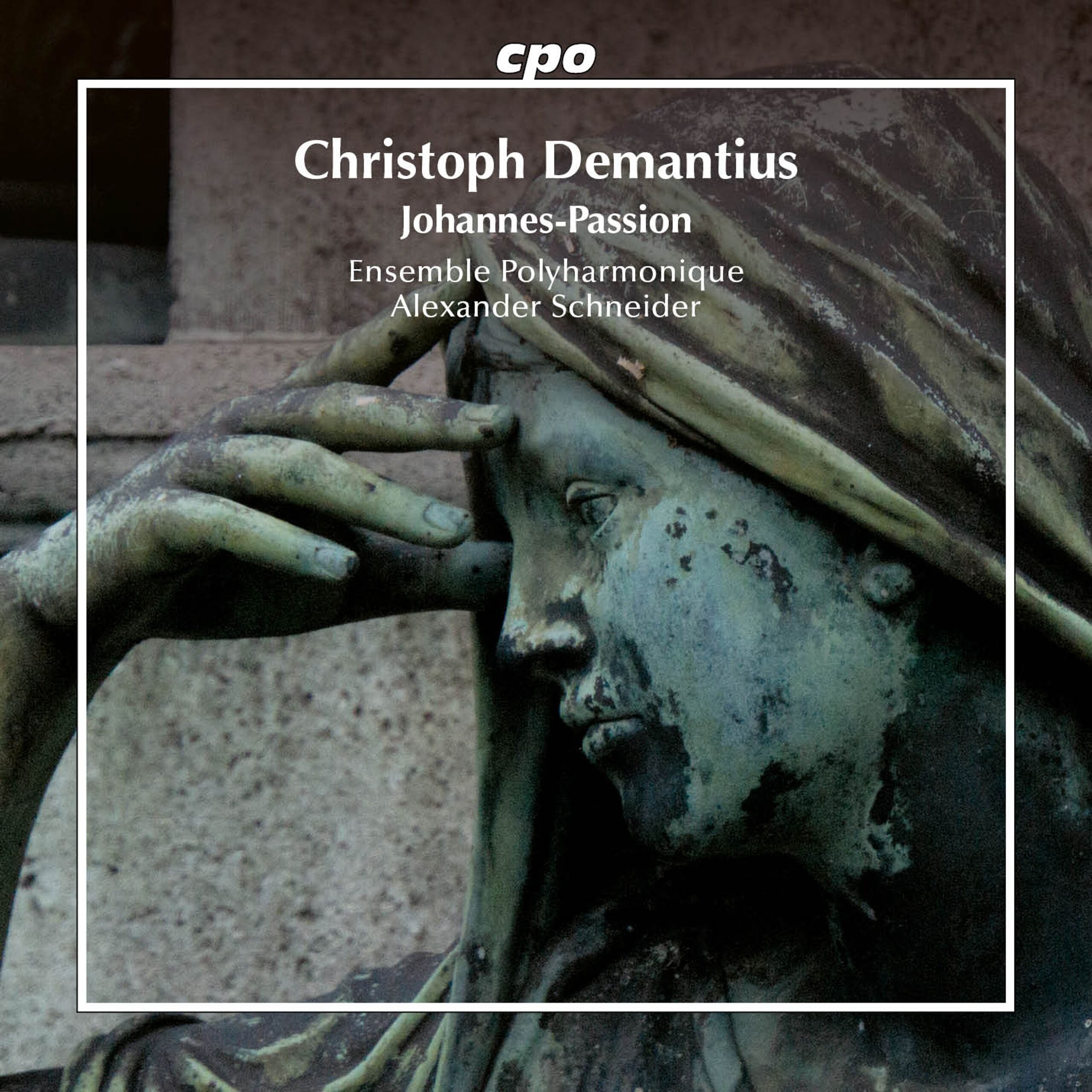
In this recording, Ensemble Polyharmonique brings new life to a long-overlooked yet remarkable work by Christoph Demantius: his St. John Passion from 1631, a gem of early German Baroque music. Performed by six vocal soloists, the Passion stands out for its collective narration, intricate polyphony, and gripping emotional depth. To enhance the spiritual atmosphere, Alexander Schneider weaved in pieces by Hammerschmidt, Schütz, Schein, and other contemporaries—recreating what a Good Friday service in 17th-century Saxony might have sounded like. This album reflects Ensemble Polyharmonique’s refined approach, blending historical insight with poetic sensitivity and committed singing.
Why does Christoph Demantius’ Johannes-Passion deserve to be rediscovered today?
Alexander Schneider: Demantius’ Johannes-Passion (St. John Passion) is particularly fascinating because it represents one of the last motet-style Passions before the emergence of the more operatic, recitative-based Passions of the Baroque era. This work deserves to be rediscovered particularly for its remarkable expressivity within a purely polyphonic framework. Unlike Künstel, Keiser, Bach or Telemann in later Passions, Demantius does not use solo recitative or instrumental accompaniment. Instead, he relies entirely on choral writing to differentiate characters and convey dramatic intensity. His use of musica reservata gives the work a deep emotional impact, despite its relatively austere structure. Furthermore, the Passion illustrates a critical moment in musical history, as the Renaissance polyphonic tradition was giving way to the new Baroque aesthetic. In this sense, Demantius’ Passion embodies both the culmination of Renaissance style and the foreshadowing of Baroque expressivity. Today, the rediscovery of the work offers performers and listeners a fresh perspective on Passion settings, distinct from the more familiar works of the 18th century. Finally, in an era where historically informed performance (HIP) has gained significant traction, Demantius’ Passion provides a unique opportunity for exploration, inviting musicians to delve into the rhetorical and declamatory aspects of early 17th-century choral music.
What musical and interpretative choices did you make to capture the essence of this Passion?
A. S.: As an ensemble, we wanted to favour a transparent, flexible vocal sound to reflect the purity of Renaissance polyphony while allowing for the heightened text declamation characteristic of early Baroque music. We opted for a more agile and speech-like delivery (instead of large, operatic voices), in order to enhance the rhetorical clarity of the text. Given the Passion’s reliance on vocal polyphony alone, careful attention to phrasing, consonant articulation, and dynamic contrasts was essential to maintain dramatic tension. We did, within historically appropriate limits, shape phrases with subtle tempo fluctuations to highlight key moments in the Passion narrative. Furthermore, the choice of pitch standard (A=466 Hz) and the use of meantone temperament brought out the expressive dissonances and harmonic colours inherent in Demantius’ writing, capturing both the austere beauty and the underlying drama of his work.
How did you shape this liturgical dramatization?
A. S.: Demantius’ Passion alternates between homophonic and polyphonic sections to differentiate roles. The words of Christ, for instance, are rendered in a solemn, almost chant-like manner, while the crowd’s interjections (turba sections) are delivered with heightened rhythmic intensity to enhance dramatic urgency. While early 17th-century music rarely indicates specific dynamics, performers can infer natural shaping from text stress. For example, Christ’s statements are sung with calm authority, whereas Pilate’s wavering indecision is reflected through slight hesitations or dynamic shifts. Furthermore, certain passages—such as Peter’s denial or the climactic moment of Christ’s crucifixion—are also subtly stretched or intensified through phrasing, making them feel more emotionally charged without breaking stylistic conventions. Finally, well-placed silences or lingering suspensions are used to heighten dramatic moments and draw listeners deeper into the Passion’s unfolding narrative. Through these interpretative choices, we have sought to transform Demantius’ Johannes-Passion from a purely liturgical work into a compelling musical dramatization of the Gospel narrative, staying true to both its sacred function and its expressive potential.
 Press review
Accompanied by lute and chamber organ, this music remains rich in sensuous appeal — thanks to the highly specialised members of Ensemble Polyharmonique, who not only sing with breathtaking purity but also convey the meaning of the text with compelling clarity.
Frank Armbruster, CONCERTI
This disc deserves a strong recommendation.
Johan van Veen, MusicWeb
Driven by a respectful depth and a shared vocal commitment that balances restraint with reverence, and devotion with harmonic continuity, this is a fine illustration of the late Renaissance that left us so many masterpieces.
Jean LACROIX, Crescendo Magazine

You must be logged in to be able to post comments.
Sign in